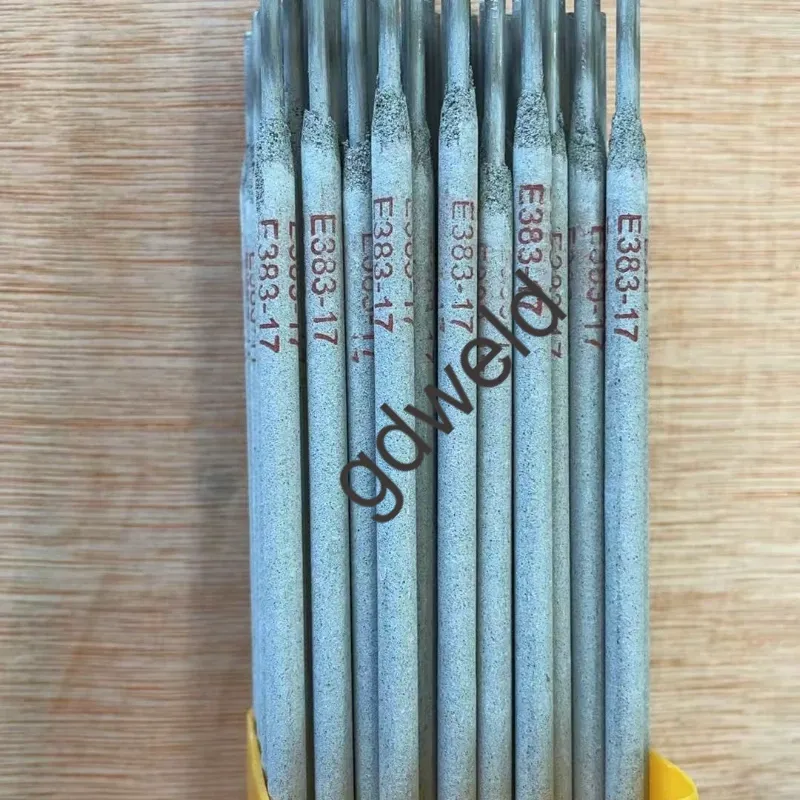
Welding Electrode
E383-16
E383-16 welding electrode is a high-alloy austenitic stainless steel electrode with Cr-Ni-Mo-Cu weld metal, designed for corrosion-resistant welding of compatible high-alloy stainless steels. It provides a stable arc, low spatter and easy slag removal for all-position SMAW welding. E383-16 is suitable for demanding chemical environments, including sulfuric and phosphoric acid service.
E383-16 Welding Electrode Features
- AWS A5.4 E383-16 classification
- High-alloy Cr-Ni-Mo-Cu austenitic weld metal
- Stable and easy-to-control arc
- Low spatter and easy slag removal
- Good weld bead appearance
- Suitable for all-position SMAW welding
- Designed for corrosion-resistant applications
- Suitable for demanding chemical service environments
E383-16 Specifications
Item | Details |
|---|---|
Classification | AWS A5.4 E383-16 |
Welding Process | SMAW |
Electrode Type | High-Alloy Austenitic Stainless Steel Electrode |
Weld Metal | Cr-Ni-Mo-Cu |
Welding Position | All positions |
Current | AC / DCEP* |
Diameter | 2.5 / 3.15 / 4.0 / 5.0 mm* |
Actual available diameters and welding parameters should be confirmed according to the current GD WELD TDS.
E383-16 Applications
E383-16 welding electrodes are intended for high-alloy stainless steel fabrication and corrosion-resistant welding applications, including:
- Chemical processing equipment
- Sulfuric acid service
- Phosphoric acid service
- Corrosion-resistant piping
- Tanks and vessels
- High-alloy stainless steel fabrication
- Maintenance and repair welding
- Selected dissimilar stainless steel joints
E383-16 may be considered for compatible grades such as 904L stainless steel (UNS N08904 / EN 1.4539) and Alloy 825 (UNS N08825 / EN 2.4858) when the required weld-metal chemistry and corrosion performance are suitable.
E383-16 Selection Guide
The selection of E383-16 should be based on the base-metal grade, service environment, required corrosion resistance and qualified welding procedure.
E383-16 should not be selected solely because an application involves 904L or Alloy 825. The compatibility of the electrode weld metal with the base material and the actual service conditions should be verified before welding.
For critical chemical-service applications, GD WELD recommends confirming the required weld-metal chemistry, welding procedure and applicable project specifications before final electrode selection.
E383-16 vs E385-16
E383-16 and E385-16 are different high-alloy stainless steel welding electrode classifications and should not be treated as interchangeable.
E383-16 uses a high-alloy Cr-Ni-Mo-Cu weld-metal system and is associated with corrosion-resistant welding applications, including demanding sulfuric and phosphoric acid environments.
E385-16 has a different weld-metal chemistry and is more specifically associated with welding Type 904L stainless steel and certain aggressive corrosion environments.
For 904L applications, the choice between E383-16 and E385-16 should therefore be based on the required weld-metal chemistry, corrosion performance, base-metal specification and qualified welding procedure.
FAQ
What is E383-16 welding electrode?
E383-16 is a high-alloy austenitic stainless steel covered electrode classified under AWS A5.4 for shielded metal arc welding. Its Cr-Ni-Mo-Cu weld metal is designed for corrosion-resistant welding applications.
What is E383-16 used for?
E383-16 is used for welding compatible high-alloy stainless steels and corrosion-resistant materials, particularly in demanding chemical environments such as sulfuric and phosphoric acid service.
Can E383-16 be used for 904L stainless steel?
E383-16 may be considered for selected 904L welding applications when its weld-metal chemistry and corrosion performance meet the project requirements. E385-16 is the more specific classification for many 904L applications.
Can E383-16 be used for Alloy 825?
E383-16 may be considered for selected Alloy 825 applications when the weld-metal chemistry, corrosion requirements and qualified welding procedure are appropriate. Final selection should be based on the specific service conditions and project requirements.
What is the difference between E383-16 and E385-16?
E383-16 and E385-16 have different weld-metal chemistries and application profiles. E383-16 is associated with high-alloy corrosion-resistant stainless steel applications, while E385-16 is more specifically associated with Type 904L stainless steel.
E383-16 Welding Electrode Supplier
GD WELD supplies E383-16 welding electrodes for industrial fabrication, maintenance and corrosion-resistant welding applications.
Contact GD WELD for E383-16 TDS, MTC, technical information and quotation.