Sep 26, 2026
Why Did My High-Strength Weld Pass Tensile Testing but Fail Impact Testing?
Why can a high-strength weld pass tensile testing but fail impact testing? Learn the common causes and how to improve weld impact toughness.
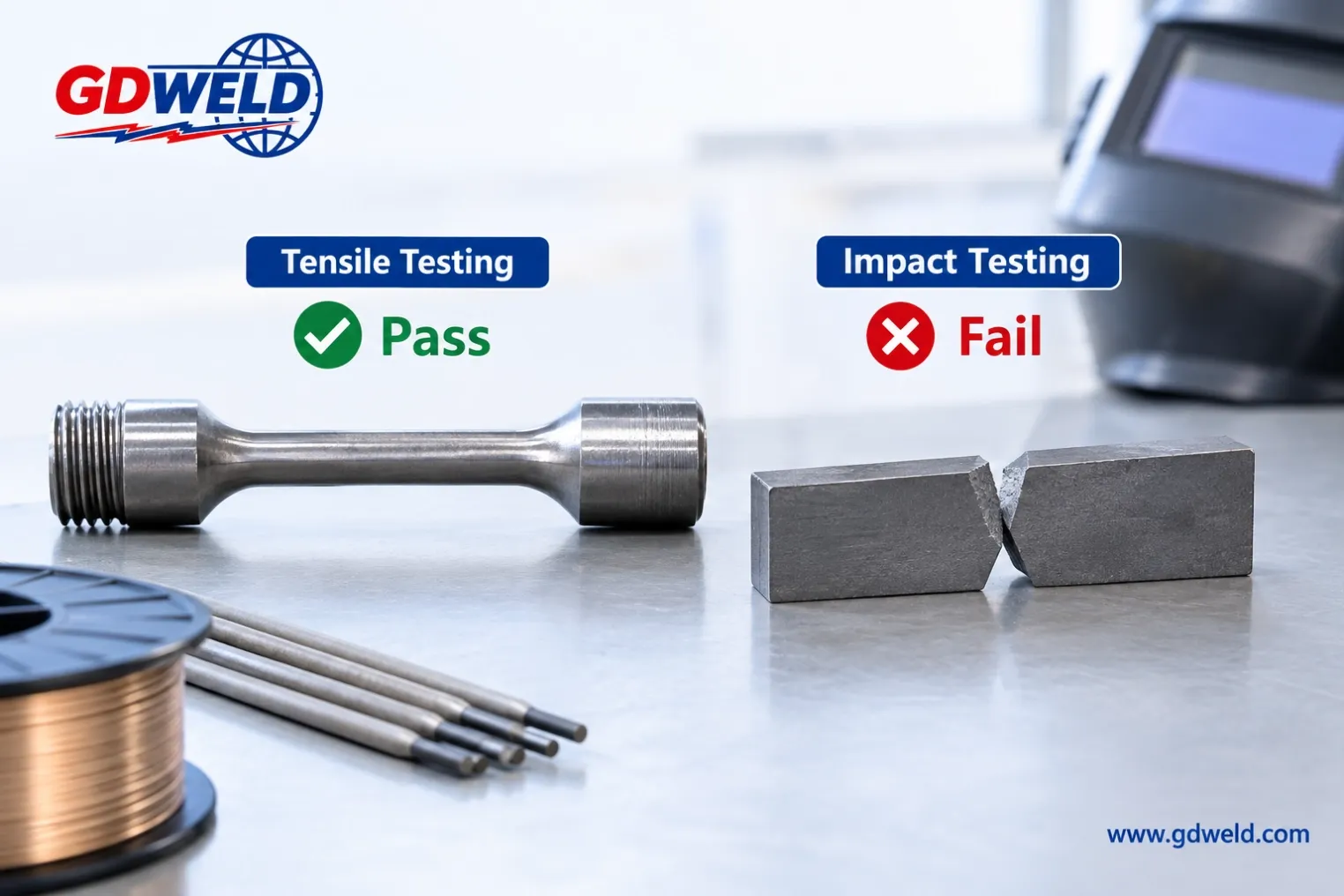
Why Can a Weld Pass Tensile Testing but Fail Impact Testing?
You completed the welding procedure qualification.
The tensile test passed, but the Charpy impact test failed.
So what happened?
This situation is possible because tensile strength and impact toughness measure different properties.
A weld can have sufficient tensile strength but still absorb too little energy during sudden fracture, especially at a low test temperature.
The problem may be related to welding consumable selection, weld-metal chemistry, heat input, cooling conditions or test temperature.
The good news is that there are several areas you can check before changing the entire welding procedure.
1. Did You Select the Welding Wire Only for Strength?
This is one of the first things to check.
When purchasing high-strength welding wire, it is easy to focus on tensile strength:
“The wire has the required strength, so it should pass.”
But this is not necessarily true.
The welding consumable also needs to provide the required impact toughness at the specified test temperature.
For example, high-strength grades such as ER100S-G, ER110S-G and ER120S-G should not be selected only by comparing tensile strength.
The base material, welding process, impact requirement and service conditions also matter.
For demanding applications, the consumable should be selected based on the complete mechanical property requirement, not strength alone.
2. Was the Impact Test Temperature Too Low?
This is another common reason for an unexpected failure.
A weld may have acceptable toughness at room temperature but show much lower impact energy at a lower temperature.
For example, a project may require Charpy testing at:
- 0°C
- -20°C
- -40°C
- or another specified temperature
The required impact energy and test temperature must therefore be checked together.
If your tensile test passed but the impact test failed, ask:
Was the Charpy test performed at the correct temperature?
Also check the required minimum absorbed energy and the applicable testing standard.
For applications exposed to low temperatures, impact toughness can be just as important as tensile strength.
3. Did the Welding Heat Input Affect Toughness?
Your welding wire may be correct, but the welding parameters can still affect the final result.
Heat input can influence the weld-metal and HAZ microstructure. Excessive heat input may produce a coarser microstructure in some welding systems, which can reduce toughness.
Check the actual:
- Welding current
- Voltage
- Travel speed
- Heat input
- Interpass temperature
- Pass sequence
Compare them with the qualified WPS.
Don't look only at the welding wire.
The same consumable can produce different weld properties under different welding conditions.
4. Is the Weld Metal Chemistry Suitable?
Weld-metal chemistry can also affect impact toughness.
Elements such as carbon, manganese, nickel, chromium and molybdenum influence the resulting microstructure and mechanical properties.
This is especially important for high-strength welding.
If the impact result is unexpectedly low, check the welding consumable's:
- Chemical composition
- Mechanical properties
- Manufacturer's test data
- MTC/CoA
- Batch information
For a critical project, consistent consumable chemistry can be just as important as achieving the required tensile strength.
For example, when using ER100S-G, ER110S-G or ER120S-G, the actual product data should be checked against the project specification rather than relying only on the AWS classification.
👉 Internal Link 1:
Anchor text: ER100S-G, ER110S-G and ER120S-G welding wires
Link to: ER100S-G / ER110S-G / ER120S-G product pages
5. Could Hydrogen or Consumable Storage Be a Problem?
For high-strength steels, hydrogen control should not be overlooked.
Moisture, contaminated joint surfaces or improperly stored consumables can introduce hydrogen into the welding process.
Depending on the material and welding procedure, hydrogen can contribute to cracking and affect weld performance.
Check:
- Consumable storage conditions
- Joint cleanliness
- Preheat requirements
- Welding environment
- Consumable handling
The exact requirements should follow the qualified WPS and applicable standard.
Quick Check: Why Did the Impact Test Fail?
If your high-strength weld passes tensile testing but fails impact testing, check these items:
1. Consumable
Does the AWS classification meet the complete project requirement?
2. Impact temperature
Was the Charpy test performed at the specified temperature?
3. Weld chemistry
Does the consumable have suitable chemical composition?
4. Heat input
Were the actual welding parameters within the qualified range?
5. Interpass temperature
Was it properly controlled?
6. Consumable condition
Were the welding wires or electrodes stored correctly?
7. Test location
Was the specimen taken from the required weld metal or HAZ location?
This checklist can help determine whether the problem is related to the consumable, welding procedure or testing conditions.
How Can You Improve Impact Toughness?
Don't automatically choose a stronger welding wire.
Instead, start with the actual requirement:
Base Material → Required Strength → Impact Toughness → Test Temperature → Welding Process → Service Conditions
If low-temperature impact toughness is important, the welding consumable should be qualified for the required impact performance.
The welding procedure should also control heat input, interpass temperature and other parameters that can affect weld microstructure.
The right consumable is therefore a balance between strength, toughness and application requirements.
👉 Internal Link 2:
Anchor text: welding consumable selection for P22 steel
Link to: Welding Consumables for P22 Steel: ER90S-B3 Wire and Electrode Selection Guide
Final Takeaway
A high-strength weld can pass tensile testing but fail impact testing because strength and toughness are not the same property.
When this happens, don't immediately change the welding wire.
First check:
Consumable → Test Temperature → Weld Chemistry → Heat Input → Interpass Temperature → Test Location
For high-strength welding, the right consumable is not simply the one with the highest tensile strength.
It is the one that meets the strength, toughness, temperature and application requirements together.