Aug 14, 2026
HSLA Steel Welding: How to Avoid Strength-Mismatch Risk with Solid Wire
Choosing wrong high-strength solid wire for HSLA steel causes under-match or over-match failures. Learn ER80S-D2 / ER100S-G selection guide for Q550-Q890 base metals
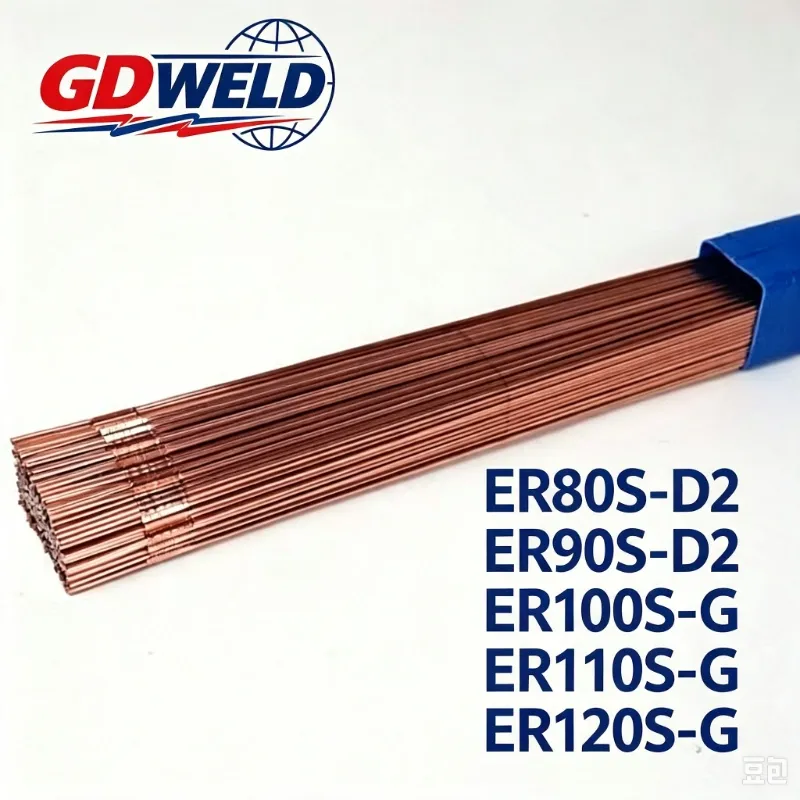
The Hidden Problem: Wrong Grade Selection
You have a high-strength low-alloy (HSLA) steel component to weld. The base metal is Q690. You pick a solid wire that seems suitable. The weld looks acceptable. But you have just made one of the most common — and costly — mistakes in structural fabrication.
The mistake? Choosing the wrong strength grade among ER80S-D2, ER90S-D2, ER100S-G, and ER110S-G.
Many fabricators assume that any wire within a broad range will work. Or they rely solely on the AWS classification without understanding the actual strength relationship between the weld metal and the base material. This is a dangerous oversimplification.
The mismatch between weld metal strength and base metal strength — known as strength-mismatch — can compromise joint integrity, even when both materials individually meet their specifications.
Understanding Strength-Mismatch — Over-Match vs Under-Match
Strength-mismatch refers to the relationship between the yield strength of the weld metal and the yield strength of the base metal. There are three possible states:
State | Definition | Risk |
|---|---|---|
Matched | Weld yield ≈ Base yield | Optimal performance |
Under-Match | Weld yield < Base yield | Premature weld failure |
Over-Match | Weld yield > Base yield | Cold cracking risk |
Under-Match: Weld Yields Before Base Plate
When you use a wire that is weaker than the base material, the weld metal is the weak link. Under tensile loading, the weld yields first. The joint fails before the base material reaches its design capacity.
This is particularly dangerous for structural applications where safety margins depend on the base material's full strength. Cranes, heavy machinery, and offshore structures are designed with specific load capacities. An under-matched weld undermines that entire design.
Real-world scenario: Welding Q690 base metal with ER80S-D2 (nominal 550 MPa yield) creates an under-match of approximately 140 MPa. The weld becomes the failure point at loads that the base metal is designed to withstand.
Over-Match: Excessive Hardness Increases Cold Cracking Risk
Using a wire significantly stronger than the base metal seems like a conservative approach. It is not.
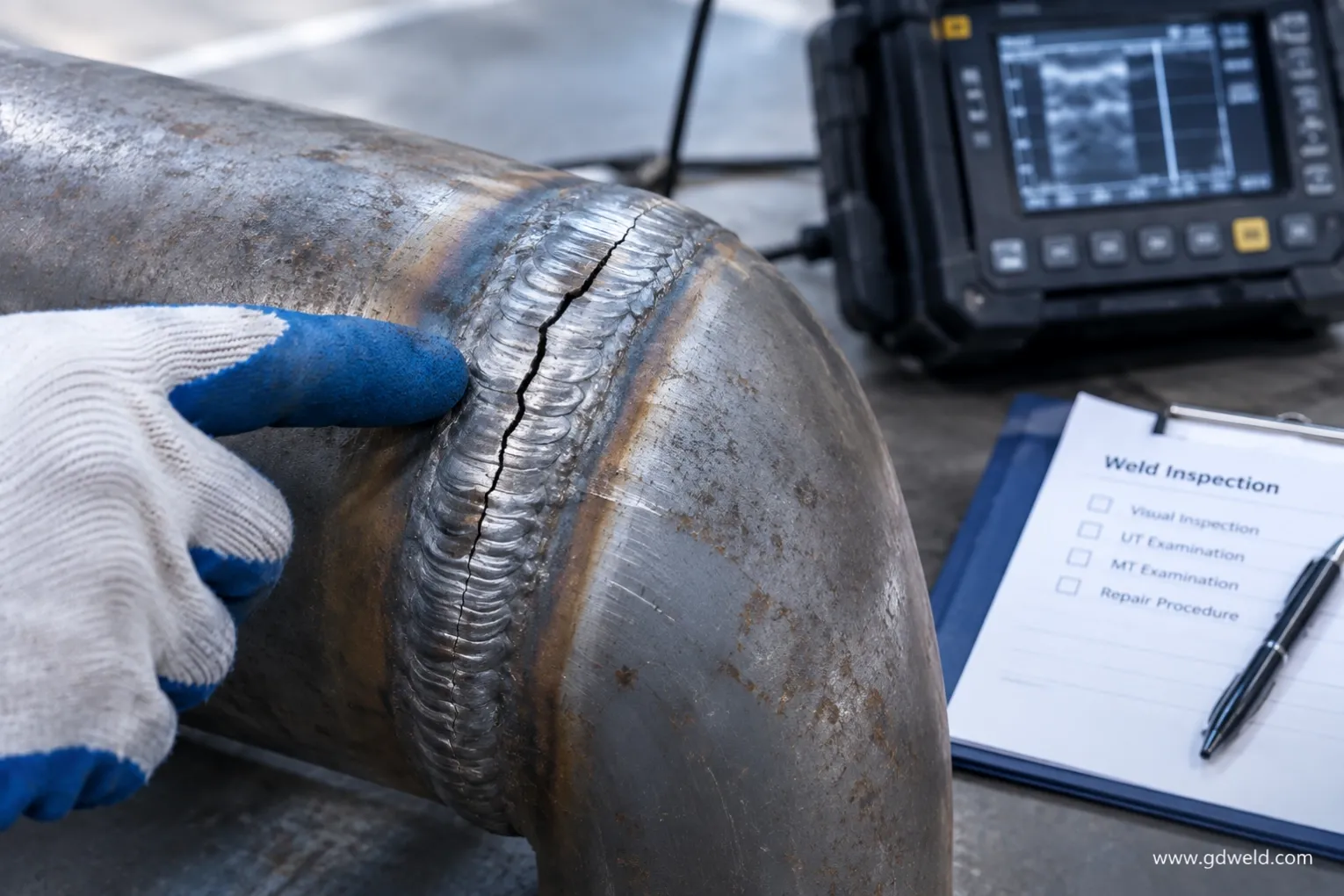
Over-matching creates weld metal that is substantially harder and less ductile than the base material. This high hardness, combined with residual stress from welding, dramatically increases the risk of hydrogen-induced cold cracking — especially in thick sections.
Real-world scenario: Welding Q550 base metal with ER100S-G (nominal 690 MPa yield) creates an over-match. The weld is much harder than the base. Under restraint, cracking can occur hours or even days after welding.
Additionally, over-matching can lead to poor stress distribution across the joint. High stress concentrations at the weld toe create another failure mechanism.
Real-World Cost: What Happens When You Get It Wrong
Strength-mismatch failures manifest in different ways depending on the mismatch direction:
Mismatch Type | Failure Mode | Consequences |
|---|---|---|
Under-Match | Weld metal deformation and fracture under load | Catastrophic joint failure, structural collapse risk |
Over-Match | Hydrogen-induced cold cracking in HAZ | Delayed failure, costly rework, scrapped components |
Both | Reduced fatigue life | Premature equipment failure, safety incidents |
In high-volume production, the financial impact is severe: rework costs, project delays, warranty claims, and reputational damage. In critical applications, the safety implications are even more serious.
How to Select the Right Wire for Your HSLA Steel
The principle is straightforward: match the weld metal yield strength to the base metal yield strength.
For common Chinese HSLA steel grades, the recommended matching is:
Base Metal | Recommended Solid Wire | Match Type |
|---|---|---|
Q550 (550 MPa yield) | ER80S-D2 (~550 MPa yield) | Matched |
Q620 (620 MPa yield) | ER90S-D2 (~620 MPa yield) | Matched |
Q690 (690 MPa yield) | ER100S-G (~690 MPa yield) | Matched |
Q890 (890 MPa yield) | ER110S-G (~790-830 MPa yield, practical match) | Near-Matched |
Note: ER110S-G offers 790-830 MPa yield, slightly under-matching Q890's 890 MPa. This is a deliberate design choice to balance strength and toughness. The weld still provides adequate joint strength while maintaining acceptable ductility and crack resistance.
Additional Selection Factors
Beyond strength matching, consider:
- Plate thickness: Thicker sections require more attention to hydrogen control and preheat
- Joint restraint: Highly restrained joints increase cold cracking risk, especially with over-match
- Service temperature: Low-temperature applications demand confirmed Charpy impact values
- Welding process: Robotic MIG welding may require tighter cast/helix control
Batch-to-Batch Consistency Matters for Reliable Matching
Strength-matching is only reliable if the wire performs consistently from batch to batch.
A wire that meets AWS classification but has significant strength variation can shift from matched to under-matched or over-matched across different batches. This is especially problematic for fabricators who qualify welding procedures with one batch of wire and later receive another with different mechanical properties.
What to look for in a reliable supplier:
- Tight chemical composition control
- Consistent mechanical properties from coil to coil
- Mill test reports with every shipment
- Traceability for all production batches
Get Professional Grade Selection Guidance
Choosing the right high-strength solid wire for HSLA welding does not have to be a guessing game.
GD-WELD offers a full range of high-strength solid wires for all HSLA matching needs:
- ER80S-D2 — ideal for Q550 base metals
- ER90S-D2 — ideal for Q620 base metals
- ER100S-G — ideal for Q690 base metals
- ER110S-G — ideal for Q890 base metals
Need help selecting the right grade for your specific application? Our technical team can provide professional guidance based on your base material, design requirements, and service conditions.
FAQs
Q: What is strength-mismatch in welding?
A: Strength-mismatch is the difference between the yield strength of the weld metal and the yield strength of the base metal. Mismatch can be under-match (weld weaker than base) or over-match (weld stronger than base).
Q: Why is under-match dangerous?
A: Under-match means the weld yields before the base plate reaches its design capacity. The joint fails at loads the base material was designed to handle, compromising structural integrity.
Q: Is over-match always bad?
A: A slight over-match (up to 50 MPa) is often acceptable and can compensate for undermatched weld metal due to dilution from lower-strength base material. However, excessive over-match increases hardness and cold cracking risk.
Q: How do I match ER110S-G to Q890 when it is slightly under-matching?
A: ER110S-G offers 790-830 MPa yield versus Q890's 890 MPa. This is a deliberate practical compromise — the wire provides sufficient joint strength while maintaining necessary toughness. For higher demands, specialized wires or multi-pass welding with higher-strength wires may be considered.
Q: Can I use ER100S-G for Q620?
A: Yes, but it creates an over-match of about 70 MPa. While acceptable in many cases, it increases cracking risk for highly restrained thick sections. ER90S-D2 provides a better match.
Q: How does base plate dilution affect strength-matching?
A: When welding, a portion of the base metal melts and mixes with the weld metal. If the base metal has lower strength, dilution reduces weld metal strength, potentially turning a matched condition into an under-match. This is the primary reason why a slight over-match is sometimes preferred.