Aug 19, 2026
Why High-Strength Solid Wire Produces More Spatter Compared with Mild-Steel Wire
ER80S-D2 / ER100S-G high-strength solid wires produce more spatter than mild steel. Learn why alloy elements and shielding gas cause spatter, and how to reduce post-weld grinding.
Why High-Strength Solid Wire Produces More Spatter Compared with Mild-Steel Wire
The Hidden Problem: More Spatter, More Grinding, Less Productivity
Welders know the drill. Switch from ER70S-6 to ER100S-G, and suddenly there is spatter everywhere. The weld bead is surrounded by tiny metal balls. The nozzle needs cleaning every few passes. The post-weld grinding takes twice as long.
This is not just an annoyance — it is a productivity killer.
Fabricators working with high-strength solid wires like ER80S-D2, ER90S-D2, ER100S-G, and ER110S-G frequently complain about excessive spatter compared to mild steel wires. The difference is noticeable, measurable, and frustrating.
But why does this happen? And more importantly — what can you do about it?
Core Reasons — Why High-Strength Wires Spatter More
Alloy Elements Change Molten Pool Surface Tension
This is the fundamental reason. High-strength solid wires contain significantly more alloying elements than mild steel wires.
Wire Grade | Key Alloying Elements |
|---|---|
ER70S-6 | Mn (1.4-1.6%), Si (0.8-1.0%) |
ER80S-D2 | Mn (1.6-2.0%), Si (0.7-1.0%), Mo (0.4-0.6%) |
ER100S-G | Mn (0.75-2.25%), Ni (0.8-2.5%), Mo (0.25-0.65%), Cr, Ti-B |
These alloying elements — particularly Mn, Mo, and Ni — change the physical properties of the molten weld pool. The surface tension increases. The viscosity changes. The droplet formation and detachment behavior differ from mild steel.
Higher surface tension means the molten droplets at the wire tip resist detaching. Instead of smoothly transferring across the arc, they agitate, bounce, or erupt — creating the fine metal particles we know as spatter.
Unmatched Welding Parameters
High-strength wires require different welding parameters than mild steel wires.
Many fabricators use the same voltage, current, and wire feed speed settings they use for ER70S-6. This is a mistake. The high-alloy chemistry demands different arc characteristics.
Common parameter issues that increase spatter:
Issue | Effect |
|---|---|
Voltage too low | Short-circuit transfer — unstable, high spatter |
Voltage too high | Long arc — erratic droplet transfer |
Current too low | Poor droplet detachment — large spatter |
Wire speed mismatched | Inconsistent burn-off rate |
Shielding Gas Type Matters
This is perhaps the most overlooked factor.
Pure CO₂ is common in mild steel MIG welding. It is inexpensive and readily available. But pure CO₂ produces a harsh arc with significant spatter — even with mild steel.
For high-strength solid wires, pure CO₂ is a disaster. The arc is unstable. The droplet transfer is irregular. Spatter levels can increase by 50-100% compared to argon-rich mixes.
The problem is twofold:
- CO₂ dissociates in the arc, absorbing energy and creating a hotter, more turbulent arc
- Higher oxidation potential — CO₂ provides more oxygen, which combines with alloy elements and disrupts smooth transfer
The Real Cost of Spatter in Production
Spatter is not just a visual issue. It has real, quantifiable costs:
Cost Area | Impact |
|---|---|
Grinding labor | 20-40% more post-weld cleaning time |
Consumable waste | Nozzle clogging, tip damage, gas diffuser replacement |
Material loss | 2-5% of wire consumed as spatter |
Weld quality | Spatter can cause porosity if trapped, and ruins surface appearance |
Robot downtime | In robotic cells, spatter clogs nozzles and requires frequent stops |
In high-volume production, reducing spatter by even 50% can save thousands of dollars annually in labor and consumables.
How to Reduce Spatter Effectively
1. Replace Pure CO₂ with 80/20 Ar/CO₂ Mixed Gas
This is the single most effective change you can make.
Shielding Gas | Spatter Level | Arc Stability | Applicability |
|---|---|---|---|
100% CO₂ | Very High | Poor | Mild steel only |
80% Ar + 20% CO₂ | Low | Good | High-strength wires |
85% Ar + 15% CO₂ | Very Low | Very Good | Critical applications |
90% Ar + 10% CO₂ | Minimal | Excellent | Spray transfer mode |
Switching from pure CO₂ to 80/20 argon mix reduces spatter by 30-50% instantly. The arc becomes smoother. Droplet transfer stabilizes. The weld appearance improves significantly.
Note: For pulse MIG applications, even higher argon percentages (92-95%) may be used.
2. Optimize Current and Voltage for Spray Transfer
For high-strength solid wires, the ideal transfer mode is spray transfer — not short-circuit or globular.
Transfer Mode | Voltage | Current | Spatter Level |
|---|---|---|---|
Short-circuit | Low | Low | High |
Globular | Medium | Medium | Very High |
Spray | High (>28V) | High (above threshold) | Very Low |
To achieve spray transfer with ER100S-G, you typically need:
- Wire diameter 1.2 mm: Current > 280-300 A
- Wire diameter 1.0 mm: Current > 220-240 A
- Voltage: Adjust to maintain stable arc (typically 28-32 V)
The spray transfer threshold is higher for alloy-rich wires than for mild steel. Once achieved, the droplets are small, smooth, and transfer axially — producing minimal spatter.
Important: Your WPS should define the correct parameters for spray transfer. Do not exceed the manufacturer's recommendations.
3. Choose Surface-Optimized High-Strength Wires
Not all high-strength wires are created equal.
Some manufacturers prioritize strength and toughness but neglect arc stability and spatter control. Surface quality, copper coating consistency, and wire drawing precision all affect how the wire feeds and how the arc behaves.
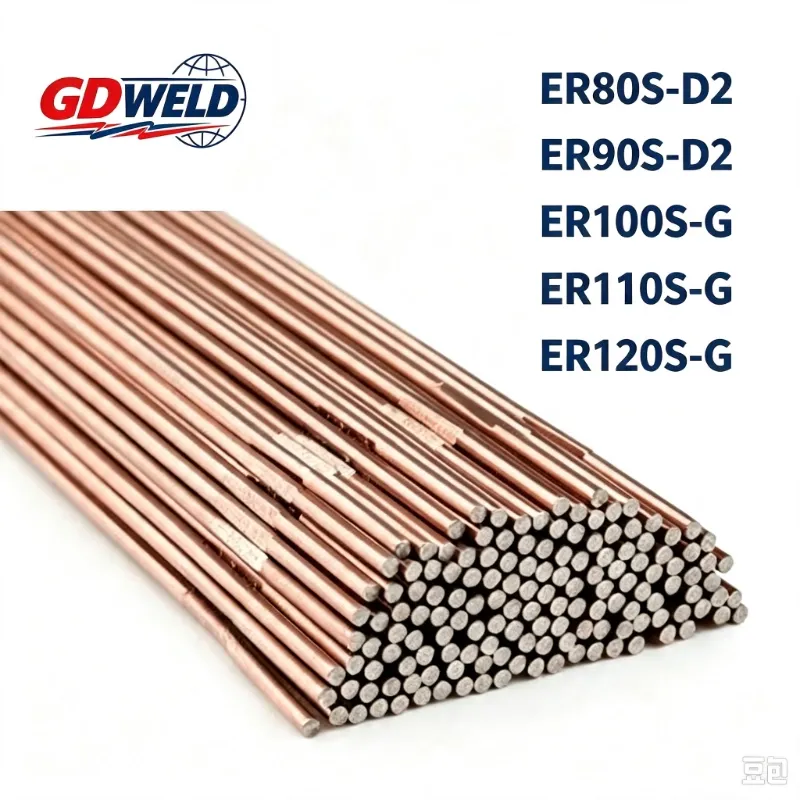
GD-WELD high-strength wires — ER80S-D2, ER90S-D2, ER100S-G, and ER110S-G — are engineered with attention to:
- Smooth wire surface — consistent copper coating, low coefficient of friction
- Precise diameter tolerance — consistent feeding and current pickup
- Optimized chemistry — formulation that promotes stable droplet transfer
The result is less spatter, even under challenging shop floor conditions.
How GD-WELD Wires Reduce Spatter Through Formulation
Beyond surface quality, GD-WELD high-strength wire series optimizes arc stability and molten pool fluidity through formulation adjustment.
Our research and production focus on:
- Balanced Mn/Si ratio — promotes stable droplet transfer and reduces surface tension effects
- Controlled trace elements — minimizes arc turbulence caused by impurities
- Consistent copper coating — ensures stable electrical contact and reduces arcing
The result: effective reduction of spatter generation and significant improvement in workshop production efficiency.
Get Cleaner Welds and Higher Productivity
Spatter does not have to be an inevitable part of high-strength welding. With the right gas, the right parameters, and the right wire, you can achieve clean, smooth welds with minimal post-weld cleaning.
GD-WELD high-strength solid wires deliver:
- Formulation optimized for arc stability and spatter reduction
- Surface quality designed for smooth feeding
- Consistent batch-to-batch performance
- Full range: ER80S-D2, ER90S-D2, ER100S-G, ER110S-G
Contact our technical team for parameter recommendations and wire samples.
FAQs
Q: Why does ER100S-G spatter more than ER70S-6?
A: ER100S-G contains more alloying elements (Ni, Mo, Cr, etc.) that increase molten pool surface tension and change droplet transfer behavior. This makes the arc less forgiving and more prone to spatter.
Q: Does pure CO₂ cause more spatter with high-strength wires?
A: Yes. Pure CO₂ produces a harsh, turbulent arc that increases spatter significantly. Switching to 80/20 Ar/CO₂ reduces spatter by 30-50%.
Q: What is spray transfer, and why does it reduce spatter?
A: Spray transfer is a welding mode where small droplets are projected axially across the arc. It is smooth, stable, and produces minimal spatter. It requires higher voltage and current than short-circuit transfer.
Q: Can I use the same parameters for ER100S-G as I use for ER70S-6?
A: No. High-strength wires typically require higher voltage and current to achieve stable spray transfer. Using mild steel parameters will cause unstable arc and increased spatter.
Q: How does GD-WELD reduce spatter in its high-strength wires?
A: GD-WELD optimizes the Mn/Si balance and controls trace elements to improve arc stability and droplet transfer. The wire surface and copper coating are also manufactured to high standards for consistent feeding.
Q: Is spatter just a cosmetic issue?
A: No. Spatter increases grinding labor, consumes nozzles and tips, reduces material yield, and can cause quality issues if trapped in the weld or if it causes arc instability. It has real cost implications.