Sep 2, 2026
Why Is ER80S-B6 Used for Cr-Mo Steel Welding
Learn why ER80S-B6 is used for Cr-Mo steel welding, including 5Cr-0.5Mo chemistry, P5 applications, ER70S-6 differences and supplier selection
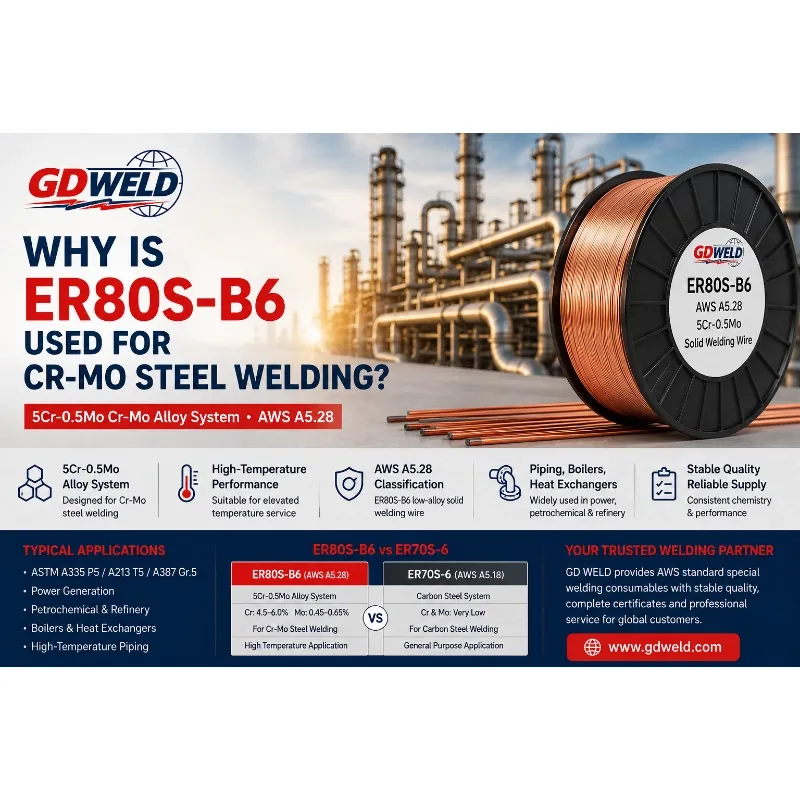
Why Is ER80S-B6 Used for Cr-Mo Steel Welding?
When welding Cr-Mo steel, choosing a welding wire based only on tensile strength can lead to the wrong filler metal selection.
Many buyers are familiar with ER70S-6, but it is not automatically a suitable replacement for ER80S-B6 when welding 5Cr-0.5Mo steels.
So, why is ER80S-B6 welding wire used for Cr-Mo steel welding?
The main reason is its 5% chromium and 0.5% molybdenum alloy chemistry, which is designed for welding compatible Cr-Mo steels used in elevated-temperature and pressure-service applications.
Quick Answer
ER80S-B6 is used for Cr-Mo steel welding because its 5Cr-0.5Mo alloy chemistry provides compatibility with specific Cr-Mo steels such as ASTM A335 P5, ASTM A213 T5 and ASTM A387 Grade 5.
Unlike conventional carbon-steel welding wires, ER80S-B6 is designed for applications where the weld metal needs to be compatible with the alloy system and service conditions of Cr-Mo steel.
The exact filler metal and welding parameters should always be confirmed according to the applicable material specification and qualified WPS/PQR.
What Makes Cr-Mo Steel Different?
Cr-Mo steels contain chromium and molybdenum as important alloying elements. They are commonly selected for components exposed to:
- Elevated temperatures
- High pressure
- Steam service
- Petrochemical processing
- Thermal cycling
For these applications, welding is not simply about joining two pieces of steel. The weld metal needs to be compatible with the base metal and the expected service conditions.
This is why welding consumable selection is particularly important for Cr-Mo piping, boilers, heat exchangers and pressure vessels.
Why Does ER80S-B6 Contain Chromium and Molybdenum?
The key feature of ER80S-B6 is its 5Cr-0.5Mo alloy system.
Chromium contributes to the alloy's resistance to high-temperature oxidation and helps provide properties required for Cr-Mo applications.
Molybdenum contributes to high-temperature strength and helps the alloy perform under elevated-temperature service conditions.
Therefore, ER80S-B6 is not simply a higher-strength version of a carbon-steel welding wire.
Its alloy chemistry is an important reason why it is selected for compatible 5Cr-0.5Mo steels.
Why Not Use ER70S-6 for P5 Cr-Mo Steel?
This is one of the most common questions from welding consumable buyers.
ER70S-6 is a widely used carbon-steel solid wire, but it should not automatically be considered a substitute for ER80S-B6 simply because it can produce a sound-looking weld.
For P5 Cr-Mo steel, filler metal selection needs to consider:
- Base-metal chemistry
- Weld-metal requirements
- Operating temperature
- Applicable welding code
- WPS/PQR requirements
- Preheat and PWHT requirements
Using a conventional carbon-steel wire may create a mismatch between the weld metal and the base metal or fail to meet project specifications.
ER70S-6 should therefore not be treated as a direct replacement for ER80S-B6 unless specifically permitted by the applicable welding procedure and engineering requirements.
What Cr-Mo Steels Are Welded With ER80S-B6?
ER80S-B6 is commonly associated with 5Cr-0.5Mo steels.
Base Metal / Specification | Typical Material |
ASTM A335 P5 | Cr-Mo alloy steel pipe |
ASTM A213 T5 | Cr-Mo alloy steel tube |
ASTM A387 Grade 5 | Cr-Mo pressure vessel plate |
ASTM A182 F5 | Cr-Mo forged components |
ASTM A217 C5 | Cr-Mo cast steel |
The exact consumable selection should always be confirmed against the applicable material specification, welding code and qualified WPS.
Where Is ER80S-B6 Welding Wire Used?
ER80S-B6 is commonly selected for industrial equipment operating at elevated temperatures or under pressure.
Typical applications include:
- Power generation and boiler systems
- High-temperature piping
- Pressure vessels
- Heat exchangers
- Petrochemical and chemical processing equipment
- Oil and gas applications
The important point is that the application determines the material, and the material helps determine the appropriate welding consumable.
What Should Buyers Check When Purchasing ER80S-B6?
For industrial buyers, finding a supplier that lists “ER80S-B6” is only the first step.
The more important question is:
Does the supplied wire actually meet the required classification and project requirements?
Before ordering, buyers should verify:
- AWS A5.28 classification
- Chemical composition
- Mechanical properties
- MTC / CoA availability
- Batch identification and traceability
- Diameter and packaging
- Consistency between batches
For critical industrial projects, documentation and consistency can be just as important as price.
How to Select ER80S-B6 Welding Wire
A practical selection process is:
1. Confirm the Base Metal
Identify the exact material specification, such as ASTM A335 P5 or ASTM A387 Grade 5.
2. Check the Welding Procedure
Review the qualified WPS/PQR and applicable welding code.
3. Verify the AWS Classification
Confirm that the product is classified as AWS A5.28 ER80S-B6.
4. Check Technical Documentation
Request the relevant chemical, mechanical and batch documentation when required by the project.
ER80S-B6 Selection at a Glance
Requirement | Why It Matters |
AWS A5.28 classification | Confirms filler-metal classification |
5Cr-0.5Mo chemistry | Supports compatibility with applicable Cr-Mo steels |
Base-metal specification | Determines material compatibility |
WPS/PQR | Confirms the qualified welding procedure |
MTC / CoA | Verifies technical data |
Batch traceability | Supports project quality control |
ER80S-B6 vs ER80S-B2 vs ER90S-B3 vs ER80S-B8
These wires are all associated with low-alloy and heat-resistant steel applications, but they are not interchangeable simply because they are all Cr-Mo welding wires.
Welding Wire | Approx. Alloy System | Typical Application |
ER80S-B2 | 1.25Cr-0.5Mo | Lower-alloy Cr-Mo steels |
ER80S-B6 | 5Cr-0.5Mo | P5 / T5 type Cr-Mo steels |
ER90S-B3 | 2.25Cr-1Mo | Higher-alloy Cr-Mo applications |
ER80S-B8 | 9Cr-1Mo | Higher-chromium heat-resistant steels |
The correct choice depends on the base metal, service conditions, welding procedure and project requirements.
Technical Note
ER80S-B6 selection should not be based on tensile strength alone.
For critical Cr-Mo welding applications, always verify the base-metal specification, applicable welding code, qualified WPS/PQR, required preheat and interpass conditions, PWHT requirements, and the manufacturer's certified technical data.
Why Choose GD WELD for ER80S-B6 Welding Wire?
GD WELD supplies AWS standard special welding consumables for international industrial applications.
For ER80S-B6, we focus on:
- Stable chemical composition
- Consistent production quality
- Technical documentation
- Batch traceability
- Export packaging
- OEM and customized supply
- Sample support for buyer evaluation
For distributors and industrial project buyers, GD WELD can provide product specifications and technical documentation to support product evaluation.
Frequently Asked Questions
Is ER80S-B6 suitable for P5 steel?
Yes. ER80S-B6 is commonly used with compatible 5Cr-0.5Mo materials such as ASTM A335 P5, ASTM A213 T5 and ASTM A387 Grade 5, subject to the applicable welding procedure.
What is the main difference between ER80S-B6 and ER70S-6?
ER80S-B6 is a low-alloy Cr-Mo welding wire with approximately 5% chromium and 0.5% molybdenum, while ER70S-6 is a carbon-steel solid wire designed for different material and service requirements.
Can ER80S-B6 be used for every Cr-Mo steel?
No. Different Cr-Mo steels require different filler metals. The base-metal specification, service conditions and qualified welding procedure must be considered.
What documents should I request when buying ER80S-B6?
Depending on the project, buyers may request a technical data sheet, chemical composition, mechanical test results, MTC/CoA, batch identification and traceability documentation.
Conclusion
ER80S-B6 is used for Cr-Mo steel welding because its 5Cr-0.5Mo alloy chemistry is designed for compatibility with specific Cr-Mo steels used in elevated-temperature and pressure-service applications.
For materials such as P5 and T5, the correct welding consumable cannot be selected by tensile strength or price alone. Base-metal chemistry, welding procedures, service conditions and technical documentation all need to be considered.
If you are sourcing ER80S-B6 welding wire for an industrial project, GD WELD can provide product specifications, technical documentation and sample support.