Oct 27, 2026
Why Does Aluminum MIG Welding Produce Porosity? Causes and Solutions
Learn what causes porosity in aluminum MIG welding and how to prevent it by checking contamination, moisture, shielding gas, wire feeding and welding settings.
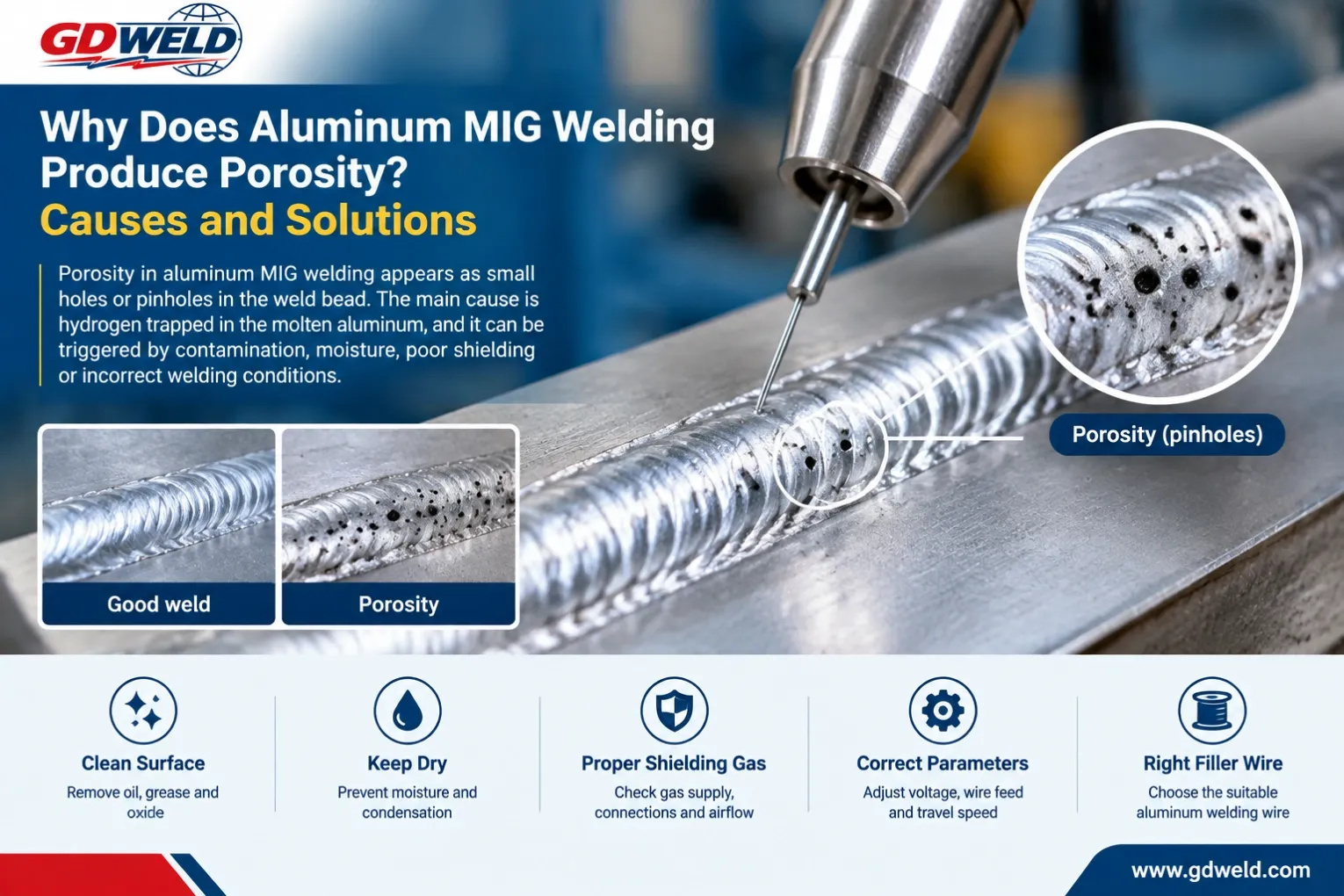
Aluminum MIG welding porosity appears as small holes or pinholes in the weld bead. These defects can reduce weld quality and may affect joint performance, especially when porosity exceeds the limits specified for the application.
The main cause is hydrogen trapped in the molten aluminum during solidification. Surface contamination, moisture, ineffective shielding gas protection and unsuitable welding conditions can all contribute to porosity.
Common Causes of Aluminum MIG Welding Porosity
Weld Problem | Possible Cause | Recommended Check |
|---|---|---|
Small holes or pinholes | Surface contamination or moisture | Clean and dry the joint |
Porosity despite normal gas flow | Gas leaks or poor shielding | Inspect hoses, torch and connections |
Porosity during outdoor welding | Wind or drafts | Protect the welding area |
Porosity after changing wire | Wire contamination or storage issues | Inspect wire condition and storage |
Recurring porosity | Incorrect welding conditions | Review parameters and wire feeding |
How to Prevent Porosity in Aluminum MIG Welding
1. Clean the Aluminum Before Welding
Oil, grease, dirt and the natural oxide layer can contribute to weld defects. Remove contaminants using an appropriate cleaning method and a dedicated stainless steel brush or suitable mechanical preparation.
Avoid contaminating the cleaned surface with bare hands, dirty gloves or workshop residue.
2. Keep Aluminum Welding Wire Dry
Moisture is an important source of hydrogen in aluminum welding. Store welding wire in a clean, dry environment and protect prepared workpieces from water and condensation.
If porosity develops after a change in storage conditions, inspect the wire and material before changing welding parameters.
3. Check Shielding Gas and Airflow
Use the shielding gas specified by the welding procedure. Argon is commonly used for aluminum MIG welding.
Check the gas supply, hoses, connections, torch nozzle and contact-area condition. Wind, drafts and excessive gas flow that creates turbulence can compromise shielding.
Normal gas flow does not always mean effective shielding at the weld pool.
4. Adjust Welding Parameters Carefully
Incorrect voltage, wire feed speed, travel speed or torch technique can contribute to unstable welding conditions. Verify the settings against the recommended procedure for the material thickness, wire diameter and joint design.
Change one variable at a time and inspect a test weld before returning to production.
5. Confirm the Correct Aluminum Welding Wire
Selecting the right filler metal is essential, but changing wire grade alone will not eliminate porosity caused by moisture or contamination.
For compatible applications, ER4043 aluminum welding wire is commonly used with many 6xxx-series aluminum alloys. ER5356 aluminum welding wire is used for suitable Al-Mg alloys and selected other applications.
Always confirm base-metal compatibility, mechanical requirements and service conditions before choosing a filler wire.
Aluminum Weld Porosity: Quick Troubleshooting Checklist
Before the next weld, check:
- Is the joint clean and free from oil or grease?
- Are the base metal and welding wire dry?
- Is shielding gas reaching the weld pool effectively?
- Is wind disturbing the shielding area?
- Are the torch, nozzle and wire-feeding system in good condition?
- Do the welding parameters match the material and procedure?
If porosity persists, use a controlled test weld to isolate the cause instead of changing several settings at once.
Frequently Asked Questions
Why does aluminum MIG welding have pinholes even with normal gas flow?
Normal flow does not rule out gas leaks, drafts, moisture or surface contamination. Inspect the entire shielding system and the joint preparation.
Can changing aluminum welding wire eliminate porosity?
Only if the wire condition or selection is contributing to the problem. Contamination, moisture and ineffective shielding must also be investigated.
What should I check first when aluminum weld porosity appears?
Start with surface cleanliness and moisture, then check shielding gas delivery, airflow, wire condition and welding parameters.
Need Aluminum Welding Wire for Your Application?
GD WELD supplies aluminum welding wire for different welding processes and applications. Share your base-metal grade, MIG wire diameter, required classification and application to help identify a suitable product.
Contact GD WELD for product specifications and supply options.