Oct 25, 2026
Why Is My E6011 Welding Rod Producing Too Much Spatter?
Is your E6011 welding rod producing excessive spatter? Learn how to check welding current, arc length, electrode angle, technique and surface contamination.
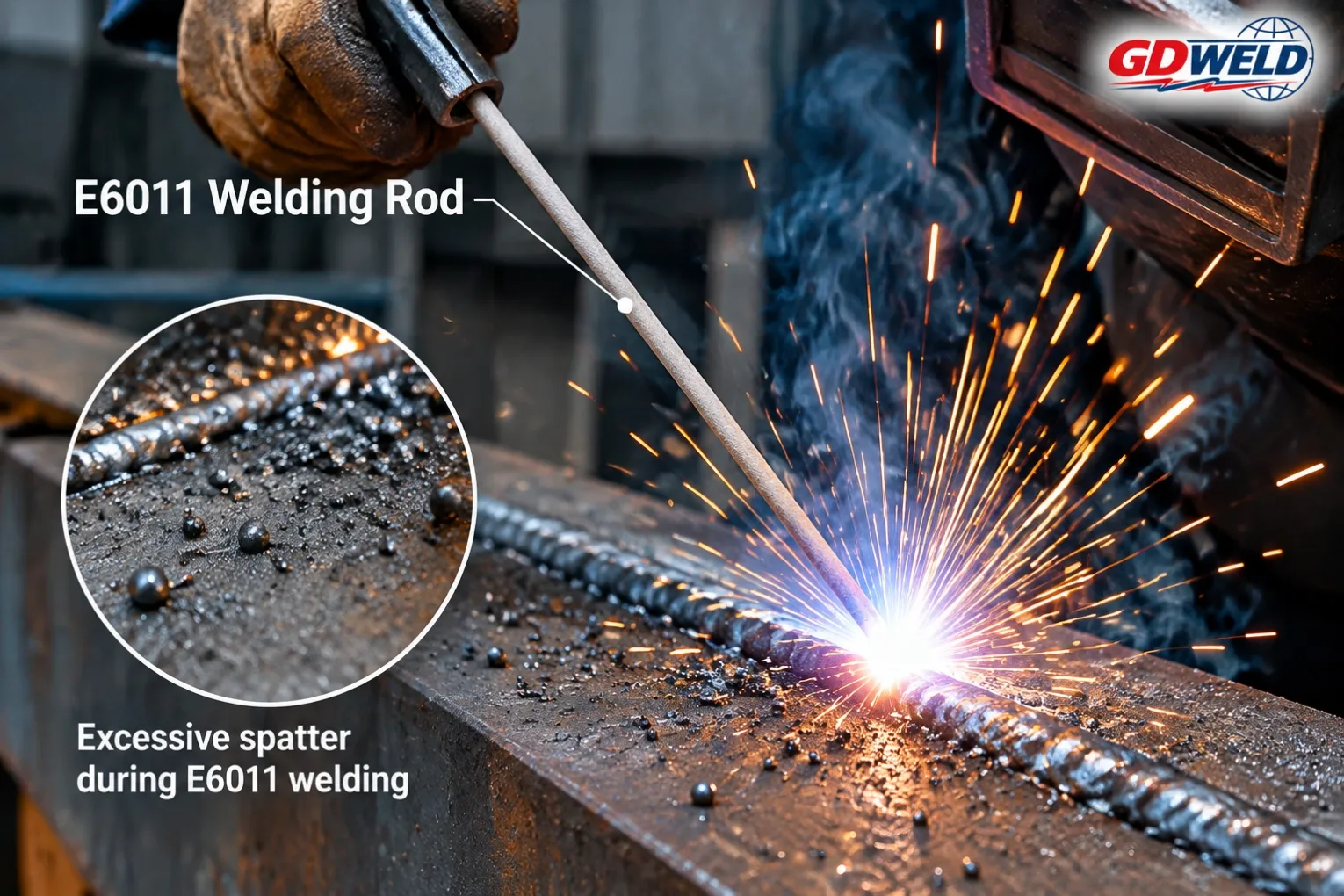
Are you spending more time removing welding spatter than completing the job? When an E6011 welding rod throws excessive metal droplets around the joint, cleanup takes longer, weld appearance suffers, and inspection or rework may become more difficult.
Some spatter is normal with E6011 because its cellulosic coating produces a forceful arc. However, excessive spatter accompanied by an unstable arc, poor bead formation or porosity deserves investigation.
Before replacing the electrodes, check these five common causes.
1. Is Your E6011 Welding Current Incorrect?
Incorrect amperage is one of the first things to check when troubleshooting excessive welding spatter.
- Current too high: The arc may become excessively aggressive, making the weld pool harder to control and increasing metal ejection.
- Current too low: The arc may become unstable, and maintaining a consistent bead can become difficult.
Check the manufacturer's recommended current range for your electrode diameter and welding position. Adjust the amperage gradually and observe whether the arc becomes more stable.
Do not use amperage alone to diagnose the problem. Electrode diameter, polarity, joint design and welding position also affect performance.
2. Are You Using an Excessively Long Arc?
An excessively long arc can make E6011 welding harder to control. It may increase spatter and contribute to an irregular bead or porosity.
How to correct it:
- Maintain a short, controlled arc appropriate for E6011.
- Keep the arc length consistent as the electrode melts.
- Avoid repeatedly lifting the electrode too far from the workpiece.
- Check whether spatter decreases when arc control improves.
If the arc sounds erratic and the bead becomes uneven, arc length is a useful early check.
3. Are Electrode Angle and Travel Speed Affecting the Weld?
Incorrect electrode manipulation can disturb the weld pool and produce inconsistent bead formation.
Common warning signs include excessive spatter on one side of the joint, uneven bead width and inconsistent penetration.
To improve results:
- Maintain a consistent electrode angle suited to the welding position.
- Use a steady travel speed.
- Follow the recommended manipulation technique for the electrode and joint.
- Avoid unnecessary wide weaving when a narrower bead is appropriate.
Change one parameter at a time whenever possible. This makes it easier to identify whether the problem comes from technique or machine settings.
4. Is the Base Metal Dirty or the Electrode Improperly Stored?
E6011 can tolerate some light rust and mill scale, but it cannot compensate for every surface condition.
Oil, grease, moisture and heavy rust can contribute to poor weld quality. Electrode condition and storage should also be checked if the arc behaves differently from one batch to another.
Before welding:
- Remove oil, grease, moisture and heavy rust around the joint.
- Check the electrode coating for damage.
- Store electrodes according to the manufacturer's instructions.
- Follow the specified cleaning requirements between passes.
If spatter occurs together with visible pores, investigate contamination and arc control rather than simply increasing the current.
5. Is the Spatter Caused by the Electrode or the Welding Setup?
If excessive spatter continues after you have checked current, arc length, technique and surface preparation, investigate the consumable itself.
Record the following information:
Check | Information to record |
|---|---|
Electrode specification | Confirm the E6011 classification |
Electrode diameter | Record the size being used |
Welding parameters | Note current and polarity |
Power source | Identify the machine and AC/DC setting |
Workpiece | Record steel grade and surface condition |
Defect symptoms | Note spatter, porosity, unstable arc or uneven beads |
Batch information | Record the package or batch details if available |
If the problem started suddenly after opening a new package, compare the new electrodes with a known-good batch under the same welding conditions.
For a fair comparison, keep the base metal, electrode diameter, current, polarity and technique as consistent as possible. If the problem persists, contact the supplier with these details so the product specification and batch information can be reviewed.
6. Should You Switch from E6011 to E6013?
Not necessarily. First determine whether excessive spatter is caused by incorrect settings or technique.
However, if you are welding suitable carbon steel and prioritize easier handling, a smoother bead and a cleaner finish, E6013 may be worth evaluating.
E6011 and E6013 have different coating systems and operating characteristics. Neither electrode is automatically better for every application. Consider base-metal thickness, required penetration, welding position, power source and project specifications before switching.
Compare the E6011 welding electrode and E6013 welding electrode to review their intended applications.
Final Troubleshooting Checklist
If your E6011 welding rod is producing too much spatter, work through these checks in order:
- Verify the recommended current range and polarity.
- Maintain a short, controlled arc.
- Check electrode angle and travel speed.
- Clean the base metal and inspect electrode condition.
- Compare performance under consistent welding conditions.
- Contact your supplier if abnormal spatter persists.
Reducing unnecessary spatter can improve weld appearance and reduce post-weld cleanup, but the goal is not to eliminate every spark or droplet. The priority is a stable arc and a weld that meets the required quality criteria.
Need E6011 welding electrodes for carbon steel repair or field maintenance? Visit GD WELD's E6011 product page or contact us with your required diameter, application, welding power source and order quantity to request product information and a quotation.