Aug 24, 2026
ER80S-B6 Welding Wire: Applications, Properties and Selection Guide
Learn how ER80S-B6 welding wire is used for Cr-Mo steels, including applications, chemistry, mechanical properties, preheat, PWHT and selection factors.
ER80S-B6 Welding Wire: Applications, Properties and Selection Guide
Introduction
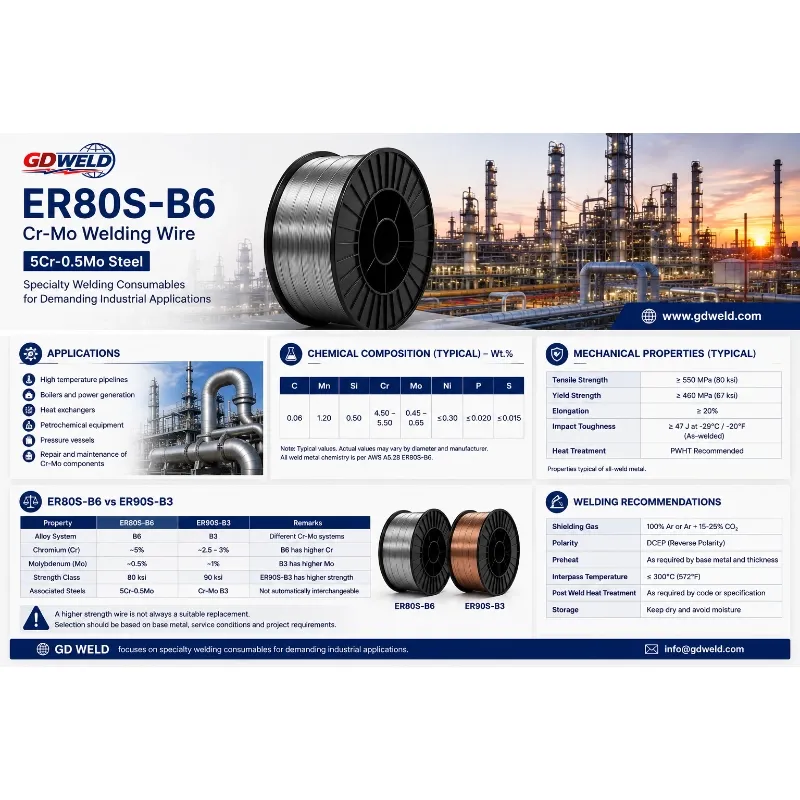
ER80S-B6 is a specialty low-alloy solid welding wire classified under AWS A5.28. It is designed for welding chromium-molybdenum steels with a nominal 5% chromium and 0.5% molybdenum composition.
Unlike general-purpose carbon steel welding wires, ER80S-B6 is selected for applications where the weld metal needs to be compatible with Cr-Mo base materials and demanding service conditions.
For engineers, welding contractors, distributors, and purchasing teams, understanding the material, application, and welding requirements is important before selecting ER80S-B6.
What Is ER80S-B6?
ER80S-B6 is a gas-shielded solid welding wire for low-alloy Cr-Mo steels. Its AWS A5.28 classification is associated with a weld metal chemistry containing approximately 4.5–6.0% chromium and 0.45–0.65% molybdenum within the classification limits.
The chromium-molybdenum alloy system is intended for applications where elevated-temperature performance and compatibility with similar Cr-Mo steels are important.
ER80S-B6 may be used with GTAW and, depending on product design and application, GMAW. The appropriate process, shielding gas, polarity, wire diameter, and parameters should always be confirmed against the applicable product technical data and welding procedure.
Where Is ER80S-B6 Used?
ER80S-B6 is commonly associated with welding 5Cr-0.5Mo steels and similar low-alloy materials.
Typical application areas include:
- Power generation equipment
- Boilers and heat exchangers
- High-temperature piping and tubing
- Pressure vessels
- Petrochemical and chemical processing equipment
- Refinery applications
- Repair of components made from similar Cr-Mo alloys
The exact application should be evaluated against the base-metal grade, service temperature, design requirements, welding procedure, and applicable code.
Why Choose ER80S-B6 Instead of a General-Purpose Welding Wire?
The main reason is material compatibility.
A general-purpose carbon steel wire may be suitable for ordinary carbon steel fabrication, but it is not automatically an appropriate choice for a Cr-Mo component operating under demanding conditions.
ER80S-B6 is designed around a specific alloy system. Its chromium and molybdenum content helps produce weld metal intended for compatibility with 5Cr-0.5Mo-type materials.
For critical applications, welding consumable selection should consider more than tensile strength alone. Engineers may also need to evaluate:
- Base-metal chemistry
- Required weld-metal chemistry
- Tensile and yield strength
- Service temperature
- Preheat and interpass temperature
- Post-weld heat treatment (PWHT)
- Hydrogen control
- Welding position and process
- Applicable construction codes and project specifications
ER80S-B6 Chemical Composition
The characteristic alloy system includes chromium and molybdenum as its principal alloying elements. Typical AWS A5.28 classification limits include:
Element | Classification Requirement |
|---|---|
Carbon (C) | 0.10% max. |
Manganese (Mn) | 0.40–0.70% |
Silicon (Si) | 0.50% max. |
Chromium (Cr) | 4.50–6.00% |
Molybdenum (Mo) | 0.45–0.65% |
Nickel (Ni) | 0.60% max. |
Phosphorus (P) | 0.025% max. |
Sulfur (S) | 0.025% max. |
Copper (Cu) | 0.35% max. |
Actual product chemistry can vary within the applicable classification limits. The manufacturer's current mill certificate or technical data sheet should be used for qualification and purchasing decisions.
Mechanical Properties
AWS A5.28 classification requirements for ER80S-B6 include minimum tensile strength, yield strength, and elongation requirements. Reported values can vary depending on welding process, shielding gas, heat treatment, and testing condition.
Typical classification-level values are around 550 MPa (80 ksi) minimum tensile strength, 470 MPa (68 ksi) minimum yield strength, and 17% minimum elongation.
For engineering applications, the applicable specification, WPS/PQR, testing condition, and product documentation should be used rather than relying on a single typical value.
Preheating and PWHT Considerations
ER80S-B6 is used for low-alloy Cr-Mo applications where thermal control can be important.
Preheating, interpass temperature control, and post-weld heat treatment may be required depending on the base material, thickness, welding procedure, applicable code, and service conditions.
Some ER80S-B6 product data recommends preheating in the approximate range of 177–232°C. This should not be treated as a universal requirement. The actual temperature range must be established from the applicable WPS, code, base-metal grade, thickness, and project requirements.
Proper thermal control can help reduce the risk of hydrogen-assisted or cold cracking and support the required weld-metal properties.
ER80S-B6 vs. ER80S-B2
Both ER80S-B2 and ER80S-B6 are Cr-Mo low-alloy welding wires, but they are not interchangeable simply because they belong to the same general family.
ER80S-B2 is associated with a lower chromium content, while ER80S-B6 is designed around the 5Cr-0.5Mo alloy system.
The correct choice depends on the base-metal specification and the required weld-metal chemistry and performance.
When selecting between the two, compare:
- Base-metal grade
- Required weld-metal chemistry
- Service temperature
- Mechanical property requirements
- PWHT requirements
- Applicable welding code or project specification
How to Select the Right ER80S-B6 Welding Wire
Before placing an order, provide the supplier with as much technical information as possible.
Recommended information includes:
- AWS or other required classification
- Base-metal grade
- Welding process
- Required wire diameter
- Shielding gas
- Welding position
- Required mechanical properties
- Service temperature
- PWHT requirements
- Applicable standard or project specification
- Required certification or inspection documents
- Packaging requirements
This information helps confirm whether ER80S-B6 is the appropriate consumable and whether the available product can meet the project requirements.
Why ER80S-B6 Is a Specialty Welding Consumable
ER80S-B6 is a good example of a welding consumable that should be evaluated by application rather than price alone.
It is used for specific low-alloy Cr-Mo materials and demanding industrial applications. Customers may require a particular AWS classification, chemistry range, mechanical properties, diameter, certification package, or production consistency.
For buyers who need less-common or application-specific welding consumables, the ability to source the correct grade consistently can be as important as unit price.
GD WELD focuses on specialty welding consumables, including less-common welding wires and electrodes for demanding industrial applications.
Conclusion
ER80S-B6 is a specialty low-alloy welding wire for Cr-Mo applications where material compatibility and service performance are important.
When selecting ER80S-B6, consider the complete welding system—not only the consumable classification. Base-metal chemistry, welding procedure, preheat, interpass control, PWHT, mechanical requirements, and applicable codes should all be evaluated.
GD WELD supplies specialty welding consumables for demanding applications and supports customers looking for specific welding grades, diameters, technical requirements, and documentation.
Looking for ER80S-B6 or another specialty welding consumable? Contact GD WELD with your required classification, base material, diameter, application, and documentation requirements.