Aug 31, 2026
What Mistakes Buyers Make When Purchasing High-Strength Solid Wire
High-Strength Solid Wire Purchasing Guide: Mistakes Buyers Make (ER100S-G)" meta_description: "Don't buy ER80S-D2 / ER100S-G on price alone.
What Mistakes Buyers Make When Purchasing High-Strength Solid Wire
The Hidden Problem: Price and AWS Grade Are Not Enough
You have a high-strength welding project. You know you need ER100S-G or ER80S-D2. You search online, compare prices, and place an order with the cheapest supplier that offers the right AWS grade.
The wire arrives. It looks like welding wire. It has the correct AWS classification printed on the box.
Then you start welding.
And the problems begin: porosity, spatter, unstable arc, failed impact tests, inconsistent batches. Weld rejection. Rework. Project delays. Angry customers.
What went wrong?
Most buyers focus on two things: price and AWS grade. They assume that if the wire meets the AWS classification, it will perform the same as any other wire with the same classification.
This is a dangerous assumption.
4 Common Purchasing Mistakes — And Why They Cost You
Mistake #1: Buying on Price Alone
Price is not the same as cost.
The lowest-priced wire may seem like a bargain. But when it causes welding defects, grinding, rework, and project delays, the total cost is far higher than the "savings" on the purchase price.
Cost Factor | Low-Price Wire | Quality Wire |
|---|---|---|
Price per kg | Low | Higher |
Rework rate | High (5-15%) | Low (<1%) |
Grinding labor | High | Low |
Project delays | Frequent | Rare |
Total cost | Much higher | Lower |
The cheapest wire is rarely the most cost-effective wire.
Mistake #2: Trusting AWS Grade Without Verifying Performance
AWS grade is a minimum standard, not a guarantee of performance.
Two wires with the same AWS classification can have very different mechanical properties. One may meet the tensile minimum. The other may exceed it comfortably. One may pass impact testing. The other may barely scrape through.
Why does this happen?
Because AWS specifications allow wide chemical tolerance ranges. A supplier can hit the minimum requirements and still sell the wire as "ER100S-G." But that wire will not perform the same as a wire manufactured with tighter tolerances and higher quality standards.
Always verify performance — do not assume.
Mistake #3: Ignoring Batch-to-Batch Consistency
You test one batch. It performs well. You place a large order. The next batch arrives — and it is different.
This is one of the most common sourcing mistakes. Buyers test a sample and assume all subsequent batches will be the same. They are not.
Inconsistent wire means:
- Procedure qualifications that no longer apply
- Welding parameters that need constant adjustment
- Unpredictable mechanical properties
- Hidden quality variation that affects weld soundness
Batch consistency is not optional for critical applications.
Mistake #4: Skipping Sample Welding Tests
"Sample welding test" is not a checkbox. It is not a formality. It is the only way to confirm that a wire will perform in your specific application.
Many buyers skip this step to save time. They order production quantities based on a datasheet. The results are often disappointing.
Sample welding tests should include:
- Welding with your actual parameters
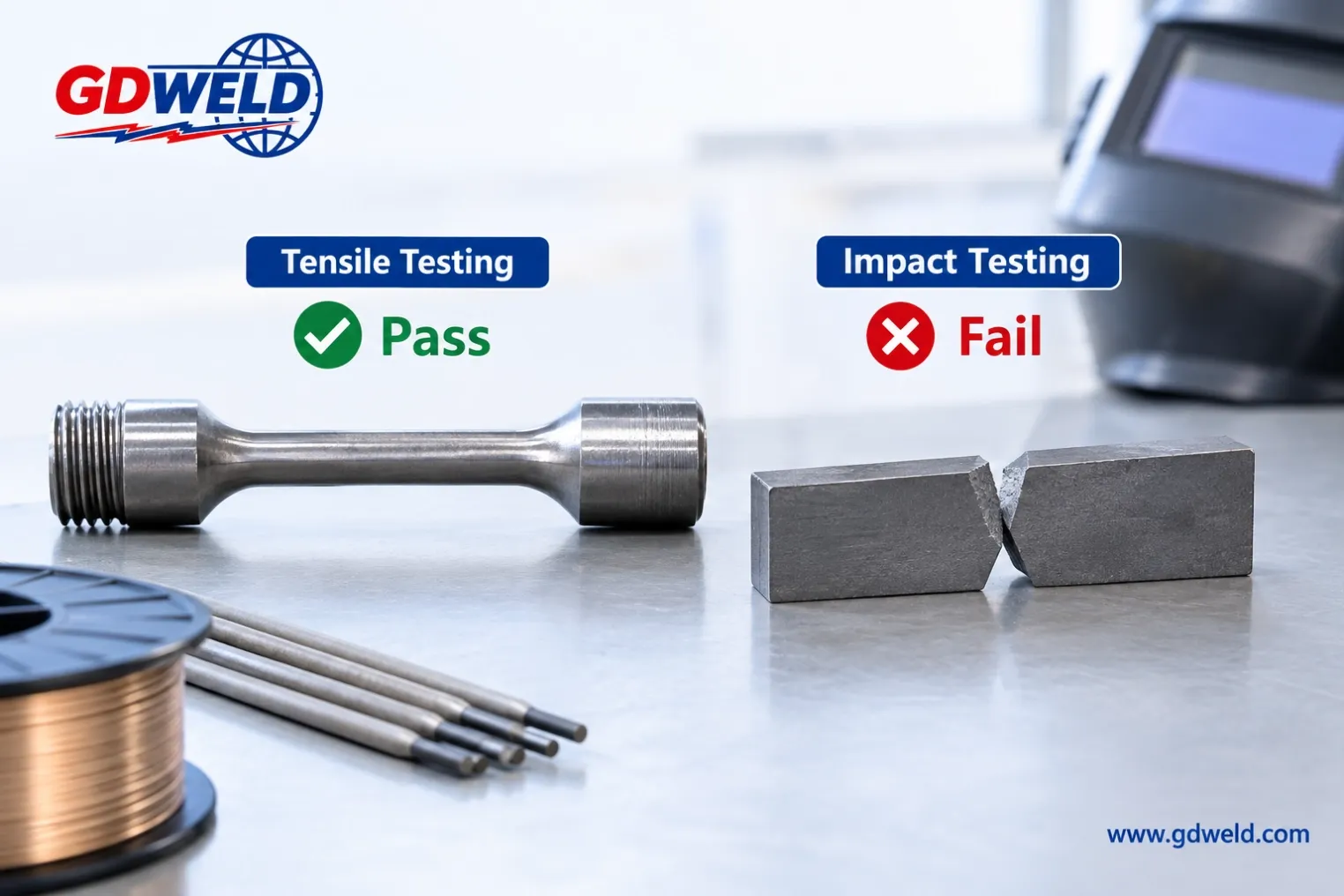
- Tensile testing
- Impact testing (at required temperatures)
- Visual inspection for spatter and arc stability
- If possible, non-destructive testing (X-ray or ultrasonic)
Only after these tests should you commit to a large order.
How to Buy High-Strength Solid Wire — The Right Way
Step 1: Check Full Mechanical Test Reports — Not Just Tensile Strength
A proper mechanical test report should include:
Test | What It Verifies |
|---|---|
Tensile strength | Static load capacity |
Yield strength | Onset of plastic deformation |
Elongation | Ductility |
Charpy impact (-20°C, -40°C) | Low-temperature toughness |
Hardness | Cracking risk indicator |
Do not accept a supplier that can only provide tensile data. Demand full reports.
Note: Many "cheap" wires have tensile values that just meet the minimum requirement. Quality wires significantly exceed the minimum — providing safety margin for your application.
Step 2: Verify Raw Material Control and Batch Consistency
Ask your supplier:
- How do you inspect incoming raw materials?
- What are your internal chemical tolerance limits?
- Do you provide mill test reports for every batch?
- Can you show batch-to-batch performance data?
A supplier with good raw material control and narrow internal tolerances will produce consistent wire. A supplier without these controls will not.
What to look for:
- Narrow chemical ranges — significantly tighter than AWS minimums
- Every batch tested — not just random sampling
- Documented traceability — from raw material to finished product
Step 3: Choose Suppliers with Professional Welding Technical Support
A wire supplier should do more than deliver boxes. They should provide:
- Welding procedure recommendations
- Parameter optimization guidance
- Troubleshooting support for welding issues
- Help with qualification and certification
Suppliers that offer technical support are invested in your success — not just in selling wire.
Step 4: Conduct Sample Welding Tests Before Bulk Orders
Never place a large order without welding tests.
- Request sample spools (or purchase trial quantities)
- Weld with your actual equipment and parameters
- Test mechanical properties (tensile, impact)
- Compare results against your requirements
- Document the results for your quality records
If the supplier is unwilling to provide samples for testing — consider that a red flag.
The Real Cost of "Cheap" High-Strength Wire
Let us put numbers on the problem.
Project Size | Cheap Wire Cost | Quality Wire Cost |
|---|---|---|
Wire purchase (2,000 kg) | $4,000 | $5,500 |
Expected rework rate | 10% | 1% |
Rework labor & material | $6,000 | $600 |
Delays and schedule impact | $3,000 | $0 |
Total project welding cost | $13,000 | $6,100 |
The quality wire costs 38% more per kg. But the total project cost is 53% lower — because there is less rework, less waste, and fewer delays.
The cheapest wire is rarely the most cost-effective wire. Quality pays for itself.
Get Reliable, Certified High-Strength Solid Wire — All in One Solution
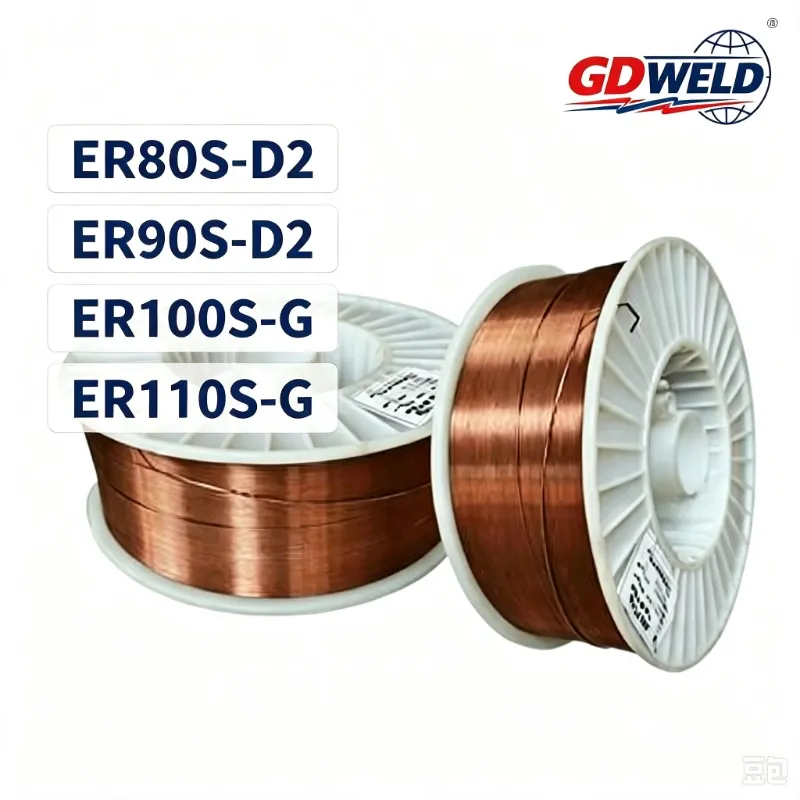
GD-WELD high-strength solid wires — ER80S-D2, ER90S-D2, ER100S-G, and ER110S-G — deliver the performance and consistency you need for critical applications.
What You Get | GD-WELD Advantage |
|---|---|
Full certifications | Mechanical test reports on every batch |
Batch stability | Narrow chemical tolerances — tighter than AWS |
Technical support | Parameter guidance and troubleshooting |
Sample testing | Trial spools and test support |
Complete range | All grades for Q550 to Q890 base metals |
We provide one-stop solutions — including sample testing, parameter guidance, and after-sales service.
Contact us for reliable quotations and technical datasheets.
FAQs
Q: Can I trust a wire just because it has the right AWS grade?
A: No. AWS grade is a minimum standard. Two wires with the same AWS grade can have significantly different mechanical properties, batch consistency, and welding performance. Always verify performance.
Q: What should I check in a mechanical test report?
A: Check tensile strength, yield strength, elongation, Charpy impact values (-20°C and -40°C), and hardness. Do not rely on tensile data alone — impact toughness is critical for high-strength applications.
Q: Why is batch-to-batch consistency important?
A: If wire properties vary between batches, your welding procedure may no longer be valid. You may need to re-qualify, adjust parameters, or face unpredictable weld quality — all costly and time-consuming.
Q: How much should I test before placing a bulk order?
A: Request sample spools and weld with your actual parameters. Perform tensile, impact, and visual testing. Confirm the results meet your requirements before committing to a large order.
Q: Is a low-priced wire ever a good deal?
A: Rarely. Low-priced wires often cause more spatter, more grinding, higher rejection rates, and project delays. The total cost is usually higher than a quality wire. Evaluate total cost, not price per kg.
Q: Does GD-WELD provide technical support?
A: Yes. We provide one-stop solutions including sample testing, welding parameter guidance, and after-sales service. Our technical team is available to help with your specific application.