Oct 26, 2026
E309L Welding Electrode: When Is It Better Than E308L?
Choosing between E309L-16 and E308L welding electrodes? Compare their typical applications, avoid common selection mistakes, and check the required classification before ordering.
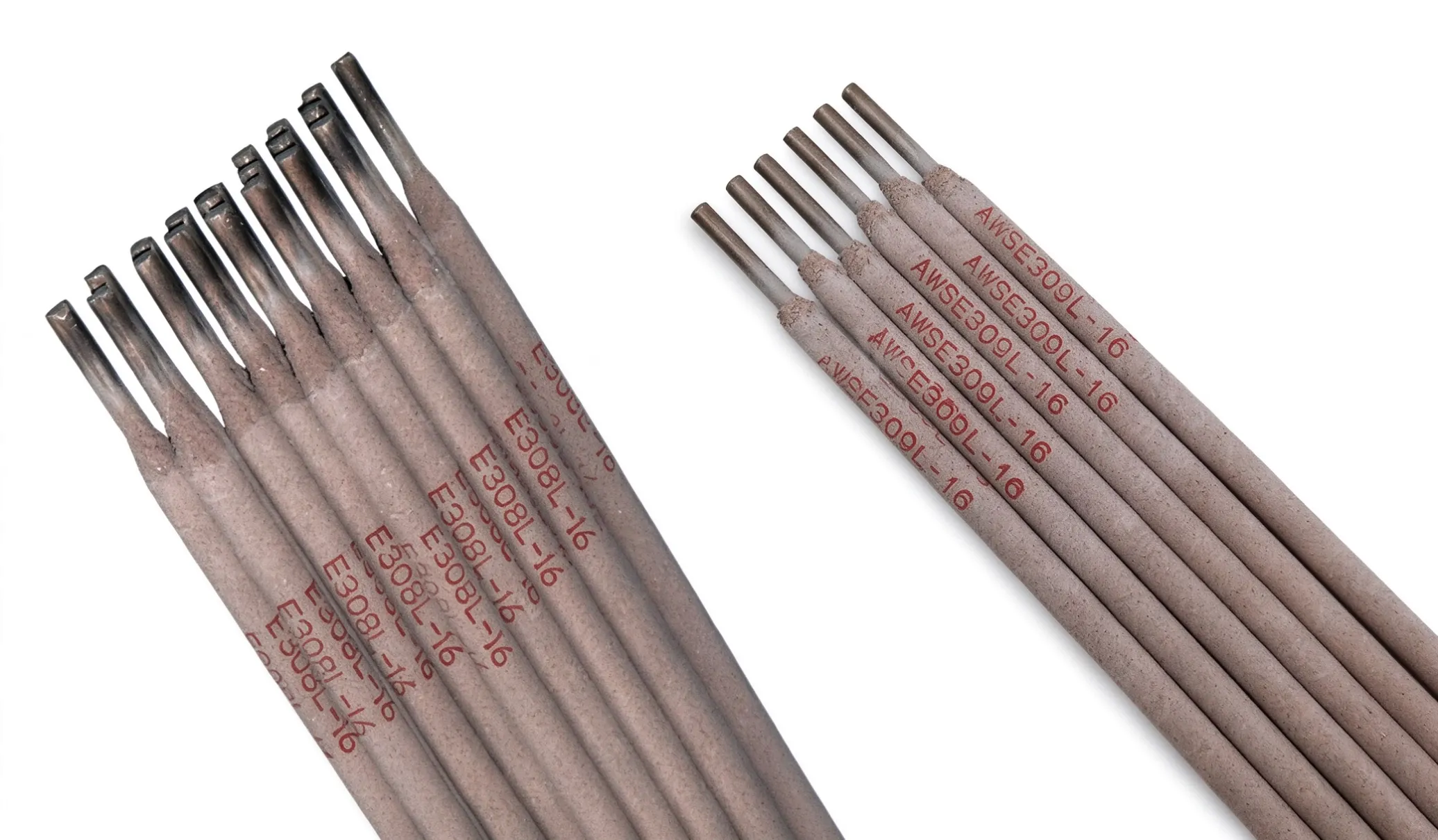
Choosing the wrong stainless steel welding electrode can lead to weld-metal compatibility issues, failed inspections or unnecessary material costs.
One common question is whether to use E309L-16 or E308L.
The answer depends mainly on the base metals being joined and the requirements of the welding procedure.
Quick guide:
- E309L-16: Commonly considered for specified stainless steel-to-carbon steel joints.
- E308L: Commonly used for compatible 304/304L stainless steel applications.
Neither electrode is suitable for every stainless steel welding job. Here is what to check before making your choice.
1. When Should You Choose E309L-16?
E309L-16 is a low-carbon chromium-nickel covered electrode with nominal weld-metal chemistry of approximately 23% chromium and 12% nickel.
Its higher alloy content makes it a common choice for specified dissimilar-metal joints where stainless steel is welded to suitable carbon steel or low-alloy steel.
Typical applications include:
- Joining compatible 304/304L stainless steel components to carbon steel
- Selected stainless steel-to-low-alloy steel joints
- Specified stainless steel cladding and buffer layers
- Industrial fabrication and repair involving dissimilar metals
Example: If a stainless steel component must be welded to a carbon steel support, E309L-16 may be a suitable starting choice when permitted by the applicable welding procedure.
Its higher alloy content helps accommodate dilution from the carbon steel, but the final weld-metal properties still depend on the materials, welding conditions and procedure.
2. When Is E308L the Better Choice?
E308L electrodes are commonly used for compatible 304 and 304L stainless steel applications.
Typical uses include:
- Stainless steel tanks and vessels
- Compatible stainless steel piping and fittings
- Food-processing equipment
- General stainless steel fabrication
When both base metals are 304/304L and the project specifies 308L-type weld metal, E308L is often the more direct choice.
Using E309L instead is not automatically an improvement. The electrode must meet the required weld-metal chemistry, mechanical properties and applicable code.
The key question is not which electrode is stronger or more corrosion-resistant in general. It is which classification meets your application requirements.
3. E309L-16 vs E308L: Key Differences
Selection factor | E309L-16 | E308L |
|---|---|---|
Electrode type | Covered stick electrode | Covered stick electrode, if the specified classification is ordered |
Typical alloy system | Higher chromium and nickel | Lower chromium and nickel than 309L-type weld metal |
Common application | Specified dissimilar-metal joints | Compatible 304/304L stainless steel |
Stainless steel to carbon steel | Commonly considered | Not usually the first choice without specific justification |
Main consideration | Base-metal dilution and joint compatibility | Matching the stainless steel grade and project specification |
These are general selection guidelines. Always verify the full AWS classification, manufacturer's technical data and qualified welding procedure.
4. Can E308L Replace E309L-16?
Do not assume that E308L is an acceptable replacement for E309L-16 in a stainless steel-to-carbon steel joint.
The two classifications have different alloy compositions and typical applications. In dissimilar-metal welding, dilution from the carbon steel can significantly influence the final weld-metal chemistry.
Before changing the specified electrode, confirm:
- Both base-metal grades
- Required weld-metal composition and properties
- Service temperature and corrosion conditions
- Applicable construction code and qualified welding procedure
If E309L-16 is specified for the joint, replacing it with E308L without technical approval may create a compliance problem.
The same principle applies in reverse: E309L-16 should not automatically replace E308L in a 304/304L joint.
5. What Should You Check Before Ordering?
Use this checklist to reduce the risk of selecting the wrong electrode.
Base metals: Identify both materials, especially if the joint combines stainless steel and carbon steel.
Complete classification: Confirm whether the requirement is E309L-16, E308L-16, E308L-17 or another classification. These designations are not automatically interchangeable.
Welding procedure: Check the approved WPS, welding position, current requirements and other applicable parameters.
Testing and documentation: Confirm any required mechanical tests, corrosion tests, technical data sheets, material test certificates and project approvals.
Order details: Specify electrode diameter, quantity, packaging requirements and delivery destination.
Providing these details helps suppliers assess the request more accurately and prepare a relevant quotation.
Find the Right Stainless Steel Welding Electrode
GD WELD supplies E309L-16 Stainless Steel Welding Electrodes for specified dissimilar-metal welding and related applications.
For compatible 304/304L stainless steel fabrication, see our E308L-17 Stainless Steel Welding Electrode. E308L-17 is a specific coating classification, so confirm that it meets your project requirements rather than assuming it can replace every E308L electrode.
If you are comparing solid welding wires rather than stick electrodes, read our guide to ER309L vs ER308L Welding Wire.
Need help sourcing E309L-16 electrodes? Send GD WELD your base-metal grades, required AWS classification, electrode diameter, order quantity and destination to request product information and a quotation.