Sep 20, 2026
ER90S-B3 vs ER90S-B9: Key Differences for P22 and P91 Steel Welding
Learn the key differences between ER90S-B3 and ER90S-B9 welding wire for P22 and P91 steel. Compare alloy chemistry, applications, welding requirements and selection.
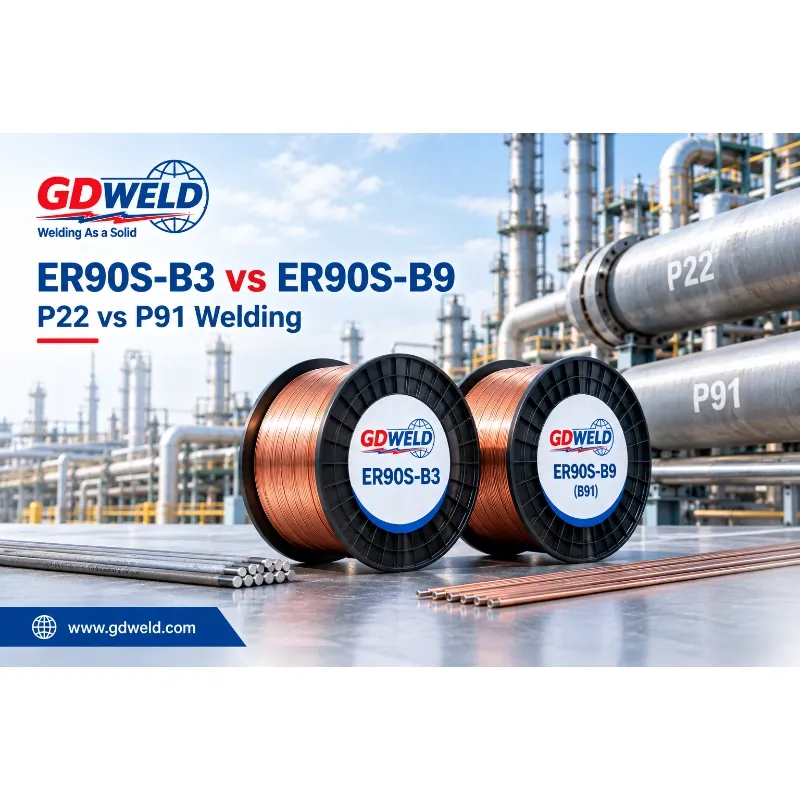
ER90S-B3 vs ER90S-B9: What Is the Difference?
Choosing between ER90S-B3 and ER90S-B9 welding wire is not simply a matter of comparing tensile strength.
Both are low-alloy Cr-Mo welding consumables designed for high-temperature service, and both are commonly associated with power plants, refineries, pressure piping and other demanding applications.
But they are designed for different Cr-Mo steel families.
In simple terms:
- P22 steel → ER90S-B3
- P91 steel → ER90S-B9 / ER90S-B91
Using the wrong filler metal can create a much bigger problem than simply failing to meet a purchasing specification. The weld may look acceptable while the filler-metal chemistry does not match the service requirements of the base metal.
So, what is the actual difference?
ER90S-B3 vs ER90S-B9: Quick Comparison
Item | ER90S-B3 | ER90S-B9 / B91 |
Typical base metal | P22 / T22 | P91 / T91 / F91 |
Cr level | About 2.25% | About 9% |
Mo level | About 1% | About 1% |
Alloy family | 2.25Cr-1Mo | 9Cr-1Mo-V-Nb |
Typical process | GTAW / GMAW | GTAW / GMAW |
Typical application | High-temperature piping and pressure equipment | High-temperature, creep-resistant power equipment |
AWS family | A5.28 | A5.28 |
Typical strength class | 90 ksi | 90 ksi |
ER90S-B3 is designed around the 2.25Cr-1Mo system used for P22/T22 steels. Typical ER90S-B3 chemistry contains approximately 2.3–2.7% Cr and 0.9–1.2% Mo.
ER90S-B9, now designated ER90S-B91 in newer AWS classification terminology, belongs to the much higher-alloy 9Cr-1Mo-V-Nb family used with P91/T91/F91 steels. Typical chemistry includes approximately 8.5–9.5% Cr, around 1% Mo, plus controlled additions of V, Nb and N.
1. ER90S-B3 Is for P22 — ER90S-B9/B91 Is for P91
This is the first thing buyers should check.
Do you know what is ER90S-B3?
Please visit,
ER90S-B3 for P22
P22 is a 2.25Cr-1Mo low-alloy steel commonly used in high-temperature and high-pressure piping and equipment.
ER90S-B3 is specifically designed for this alloy family and is commonly used for P22/T22 applications.
Typical applications include:
- Boiler piping
- Steam piping
- Pressure vessels
- Refineries
- Petrochemical equipment
- High-temperature piping systems
ER90S-B9/B91 for P91
P91 is a very different material.
It is a modified 9Cr-1Mo steel with additions such as vanadium and niobium to achieve improved high-temperature and creep performance.
For P91 applications, ER90S-B91 is the corresponding gas-shielded solid wire classification.
Typical applications include:
- Main steam piping
- Boiler headers
- Power-generation equipment
- Turbine components
- High-temperature pressure systems
The important point: P22 and P91 may both operate at high temperatures, but their alloy systems and welding requirements are different.
2. The Biggest Difference Is Chromium Content
The easiest way to understand the difference is to look at the alloy chemistry.
ER90S-B3: approximately 2.25% Cr + 1% Mo
ER90S-B9/B91: approximately 9% Cr + 1% Mo, with controlled V, Nb and N additions.
That is a major difference.
The higher chromium and controlled alloying system of B91 are associated with the creep-resistant metallurgy required for P91-class steels. Lincoln Electric, for example, describes its ER90S-B9 product as a modified 9CrMo filler designed for Type 91 steels and long-term creep resistance.
This is why ER90S-B3 should not be treated as a lower-cost substitute for ER90S-B9/B91 on P91.
Likewise, B9/B91 is not simply a stronger version of B3 that can automatically replace B3 on P22.
3. Why Can't ER90S-B3 and ER90S-B9 Be Interchanged?
This is one of the most important questions for welding consumable buyers.
Both classifications have a nominal tensile-strength level of around 90 ksi, but tensile strength alone does not determine whether a filler metal is suitable.
The alloy chemistry, heat treatment response, weld-metal microstructure and high-temperature performance also matter.
For P22, the weld metal needs to be compatible with the 2.25Cr-1Mo system.
For P91, the consumable needs to support the much more highly alloyed 9Cr-1Mo-V-Nb system and its demanding heat-treatment requirements.
So a supplier saying:
“Both wires are 90 ksi, so either one should work.”
is a red flag.
Strength class is only one part of consumable selection.
4. P22 vs P91: The Welding Control Is Also Different
Another common purchasing mistake is to focus only on the wire itself.
Cr-Mo welding performance also depends heavily on:
- Preheat temperature
- Interpass temperature
- Welding heat input
- Welding process
- Post-weld heat treatment
- Cooling conditions
- WPS/PQR requirements
Do you know,
What Are Cr-Mo Welding Consumables? Grades, Materials and Applications?
Please visit,
For example, published technical information for ER90S-B3 shows controlled preheat and interpass requirements for Cr-Mo welding.
P91 is even more demanding because its metallurgy is specifically designed for high-temperature creep service. P91 welding therefore requires much tighter control of consumable chemistry and thermal treatment.
The filler metal cannot be selected independently from the welding procedure.
5. What About ER90S-B9 vs ER90S-B91?
If you are purchasing P91 welding wire, you may see both names in supplier documents.
This can cause confusion.
AWS A5.28:2020 introduced ER90S-B91 and replaced the earlier ER90S-B9 classification.
Therefore, buyers should check the exact standard edition and project specification rather than assuming that “B9” and “B91” are simply different grades.
For current projects, it is especially important to verify:
- AWS/ASME classification
- Applicable specification edition
- Chemical composition
- Mn + Ni limits
- V, Nb and N content
- Mechanical properties after PWHT
- Project WPS/PQR requirements
This is particularly important for P91 because small chemistry differences can matter to long-term service performance.
6. What Should Buyers Check Before Ordering?
If you are sourcing ER90S-B3 or ER90S-B9/B91, don't send the supplier only:
“Need 1.2 mm Cr-Mo welding wire.”
That is not enough.
A better purchasing specification should include:
Base material
P22, T22, P91, T91, F91, etc.
Welding process
GTAW, GMAW or another qualified process.
AWS classification
For example:
ER90S-B3 for applicable P22 welding applications.
ER90S-B91 for applicable P91 welding applications.
Diameter
For example 1.0 mm, 1.2 mm, 1.6 mm, etc., according to the WPS.
Heat treatment
Confirm the required PWHT condition.
Documentation
Request:
- TDS
- MTC / Mill Test Certificate
- CoA
- Chemical composition
- Mechanical test results
- Batch/lot traceability
AWS A5.28 covers classification requirements for low-alloy solid and composite electrodes and rods used in gas-shielded processes, with classification based on chemistry and weld-metal mechanical properties.
7. The Most Common Buyer Mistake
The most expensive mistake is not necessarily buying the wrong diameter.
It is buying a filler metal based on a similar-looking designation without checking the base material.
For example:
P22 → B3 system
P91 → B91 system
The numbers may look similar, and both wires may have a 90 ksi tensile-strength classification, but they belong to very different alloy systems.
Before comparing price, compare:
Base Material → AWS Classification → Chemistry → Welding Process → WPS/PQR → PWHT → Documentation
That sequence is much safer than selecting the cheapest wire that appears to have the required strength.
ER90S-B3 vs ER90S-B9: Final Selection Guide
If your project involves P22/T22, start by checking whether ER90S-B3 is specified by the WPS, project specification or applicable code.
If your project involves P91/T91/F91, check for the applicable ER90S-B91 classification and the specific project requirements.
Application | Typical Consumable Direction |
P22 / T22 | ER90S-B3 |
P91 / T91 / F91 | ER90S-B91 |
P22 to P22 | B3-family consumable when specified |
P91 to P91 | B91-family consumable when specified |
P22 to P91 | Engineering/WPS-specific selection required |
For dissimilar joints such as P22 to P91, do not choose the filler metal simply by comparing the two base metals. The qualified WPS/PQR and project engineering requirements should control the selection.
Choose the Right Cr-Mo Welding Wire
ER90S-B3 and ER90S-B9/B91 are not interchangeable simply because both are 90 ksi-class welding wires.
The key difference is their alloy system:
ER90S-B3 → 2.25Cr-1Mo → P22/T22
ER90S-B91 → 9Cr-1Mo-V-Nb → P91/T91/F91
For industrial purchasing, the safest approach is to match the welding consumable to the base material, AWS classification, welding process and qualified WPS/PQR, then verify chemistry and documentation before placing the order.
GD WELD supplies specialty low-alloy welding consumables for demanding Cr-Mo applications, with product selection based on AWS classification, material grade, welding process and project requirements.